Heavy Equipment Parts Guide: Components, Applications, Materials, Functions and Selection Factors
Heavy equipment parts are the individual components that make large machines capable of digging, lifting, moving, grading, crushing, drilling, and handling materials. They are used in equipment such as excavators, bulldozers, wheel loaders, cranes, graders, dumpers, compactors, and mining machines. A heavy machine contains many connected parts, from hydraulic cylinders and tracks to filters, bearings, gears, buckets, pumps, and electronic controls.
Context
Heavy equipment parts are the individual components that make large machines capable of digging, lifting, moving, grading, crushing, drilling, and handling materials. They are used in equipment such as excavators, bulldozers, wheel loaders, cranes, graders, dumpers, compactors, and mining machines. A heavy machine contains many connected parts, from hydraulic cylinders and tracks to filters, bearings, gears, buckets, pumps, and electronic controls.
The development of heavy equipment parts is closely connected with the growth of construction, mining, agriculture, road development, and industrial operations. As machines became larger and more specialized, their components also became more varied. Different applications require parts that can withstand loads, vibration, heat, pressure, abrasion, moisture, or repeated movement.
Understanding these components helps explain how heavy equipment functions. It also provides useful background when comparing materials, identifying component functions, and understanding the selection factors that affect compatibility and machine performance.
Common Types of Heavy Equipment Parts
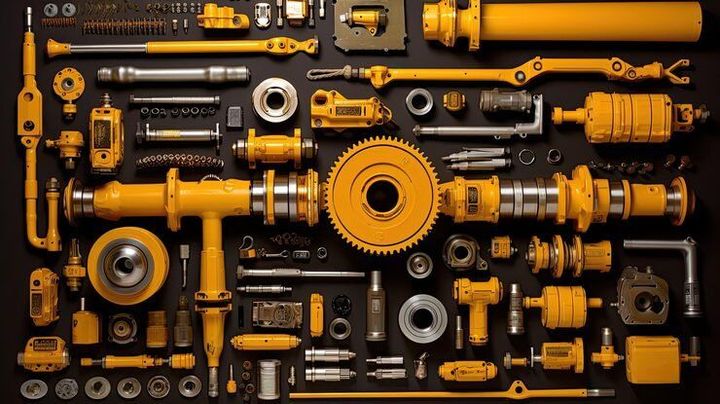
Heavy equipment parts can generally be grouped according to their function. Major groups include:
- Hydraulic components, such as pumps, valves, hoses, cylinders, and reservoirs
- Powertrain components, including engines, transmissions, axles, gears, and drive systems
- Ground-engaging parts, such as buckets, cutting edges, teeth, tracks, and rollers
- Structural components, including frames, booms, arms, chassis, and attachments
- Electrical and electronic components, including sensors, controllers, wiring, displays, and switches
- Filtration and cooling components, including air filters, oil filters, radiators, coolers, and fuel filters
Each group contributes to a different part of the machine's operation.
Importance
Heavy equipment parts matter because a large machine depends on the interaction of many components. A hydraulic excavator, for example, uses an engine or electric power source, hydraulic pumps, control valves, cylinders, hoses, structural members, tracks, and an attachment to perform digging work. A problem in one component can affect how other systems operate.
The importance of components also varies according to the application. Mining equipment may encounter abrasive materials and heavy loads, while construction equipment may experience changing ground conditions and frequent movement. Agricultural machinery can operate in dusty or wet environments, creating different requirements for filters, seals, bearings, and protective materials.
Functions of Major Components
The basic function of several common components can be summarized as follows:
| Component | Main Function | Common Applications |
|---|---|---|
| Hydraulic cylinder | Converts hydraulic pressure into linear movement | Excavators, loaders, cranes |
| Hydraulic pump | Moves hydraulic fluid through the system | Excavators, loaders, presses |
| Gear | Transfers motion and torque | Transmissions, drives |
| Bearing | Supports rotating or moving parts | Axles, motors, gear systems |
| Track | Provides traction and supports machine weight | Excavators, dozers |
| Bucket | Scoops, carries, or moves material | Excavators, loaders |
| Filter | Removes unwanted particles from fluids or air | Engines, hydraulics |
| Radiator | Transfers heat away from coolant | Engine systems |
| Sensor | Measures operating conditions | Electronic control systems |
| Cutting edge | Contacts and cuts or scrapes material | Buckets, graders, blades |
Materials Used in Heavy Equipment Parts
Material selection depends on the component's function and operating environment. Steel is widely used for structural components because it can provide strength and resistance to mechanical loads. Different steel grades and heat-treatment processes can produce different combinations of hardness, toughness, and wear resistance.
Cast iron is used in selected engine and machinery components because of its properties and ability to absorb vibration. Aluminum alloys can be used where lower weight and suitable thermal properties are important. Rubber and elastomeric materials are commonly found in seals, hoses, bushings, and vibration-isolation components.
Some modern equipment also uses engineered plastics, composites, and specialized coatings. These materials can be selected for particular requirements involving weight, corrosion resistance, friction, temperature, or electrical insulation.
Applications Across Industries
Heavy equipment components are used across several industries. Construction machines use attachments, hydraulic systems, tracks, wheels, and structural parts for excavation and material handling. Mining machines require components capable of operating under demanding loads and abrasive conditions.
Road construction equipment uses rollers, graders, pavers, cutting components, and hydraulic systems. Agriculture uses tractors, loaders, harvesters, and other machines with specialized drivetrains, hydraulic components, and attachments.
Recent Updates
From 2024 through 2026, developments in heavy equipment have increasingly involved electronic controls, machine monitoring, electrification, and safety systems. These changes are influencing the design of components used in newer equipment.
India's Ministry of Road Transport and Highways has documented changes concerning emission and safety requirements for construction equipment vehicles. The implementation of Bharat Stage CEV/Trem V emission and related safety requirements was deferred in 2024, with the revised implementation date moving into 2025.
Electric construction equipment has also received greater regulatory attention. India's road transport ministry reported requirements for electric powertrain construction equipment vehicles, including compliance with AIS-174 requirements from the applicable implementation period until corresponding BIS specifications are notified.
Electronic and Connected Components
Modern heavy equipment increasingly incorporates sensors, electronic controllers, displays, and machine-control systems. These components can monitor conditions such as temperature, pressure, position, engine parameters, and hydraulic operation.
BIS standards activity also reflects this movement. Indian standards include requirements concerning machine-control systems using electronic components and functional safety of electronic and electrical components used in safety-related control systems.
Electrification is another developing area. Electric motors, battery systems, power electronics, charging equipment, and related control components create a different component architecture from conventional diesel-powered machines. This trend can change the types of parts required for certain equipment categories.
Laws or Policies
In India, heavy equipment is influenced by a combination of vehicle regulations, machinery safety requirements, environmental rules, and Indian Standards. Requirements can vary according to the type of machine, its application, power system, and whether it falls within a particular regulated category.
The Bureau of Indian Standards maintains standards covering earth-moving machinery, including safety requirements for different machine families. These standards address areas such as machine design, operating safety, and risk reduction.
A significant regulatory development occurred with the Machinery and Electrical Equipment Safety (Omnibus Technical Regulation) Order, 2024. The original order included construction, earthmoving, and mining machinery as well as their assemblies, subassemblies, and components. The Ministry of Heavy Industries later listed amendments made during 2025 and the withdrawal of the 2024 order in January 2026. Therefore, the regulatory position should be checked against the latest official notification rather than relying on the original 2024 order alone.
Standards and Compliance
BIS maintains technical standards for earth-moving machinery and related components. Standards can address areas such as functional safety, electrical systems, dimensions, testing, machine controls, and operating requirements.
For a particular heavy equipment part, the relevant requirements can depend on the machine category and its intended application. Manufacturer specifications, applicable Indian Standards, and current government notifications are therefore important references when determining technical requirements.
Tools and Resources
Several resources can help readers understand heavy equipment components and their technical characteristics. The Bureau of Indian Standards website provides access to Indian Standards and information about standards development. Its mechanical engineering activities include work covering earth-moving equipment and material handling.
Manufacturer parts catalogs and equipment manuals can help identify component names, part numbers, dimensions, fluid requirements, and compatible machine models. Technical drawings can provide additional information about dimensions, mounting points, materials, and component relationships.
Useful resources can include:
- Parts catalogs for identifying component numbers and assemblies
- Equipment manuals for understanding operating systems
- Hydraulic diagrams for tracing fluid flow and control components
- Maintenance records for reviewing component history
- Load charts for understanding lifting equipment limits
- Measurement tools for checking dimensions and wear
- BIS databases for reviewing applicable Indian Standards
- Digital equipment-monitoring platforms for viewing machine operating information
Heavy Equipment Parts Selection Factors
Selecting a component involves more than matching its general appearance to an existing part. Important factors can include:
- Machine make, model, and production version
- Component dimensions and mounting arrangement
- Load, pressure, temperature, and operating conditions
- Material and hardness requirements
- Hydraulic or electrical specifications
- Compatibility with connected components
- Environmental conditions such as dust, water, heat, or abrasion
- Applicable safety and regulatory requirements
- Manufacturer documentation and technical specifications
Correct identification is particularly important for hydraulic, electrical, and structural components because similar-looking parts may have different specifications.
FAQs
What are the main types of heavy equipment parts?
Common categories include hydraulic components, engine and powertrain components, structural parts, ground-engaging components, electrical systems, filters, cooling components, bearings, seals, and machine attachments.
What materials are commonly used in heavy equipment parts?
Steel and cast iron are widely used for structural and mechanical components. Aluminum alloys, rubber, engineered plastics, composites, and specialized coatings are also used where their particular properties suit the application.
What selection factors matter for heavy equipment components?
Important selection factors include machine model, dimensions, load requirements, pressure, temperature, material properties, environmental conditions, system compatibility, and applicable standards.
How do hydraulic components function in heavy equipment?
Hydraulic pumps move pressurized fluid through valves and hoses. Hydraulic cylinders convert this pressure into linear movement, allowing equipment such as excavators, loaders, and cranes to move booms, arms, buckets, and other attachments.
How are heavy equipment parts changing with newer machines?
Newer equipment is incorporating more sensors, electronic controls, monitoring systems, electric powertrains, and digitally controlled hydraulic systems. These developments are creating additional types of electrical, electronic, and energy-storage components.
Conclusion
Heavy equipment parts include mechanical, hydraulic, electrical, structural, and electronic components that work together to perform different machine functions. Their materials and designs vary according to load, operating environment, movement, temperature, pressure, and application. Developments from 2024 through 2026 show increasing attention to emissions, electrification, electronic controls, and machine safety. Understanding components, functions, materials, applications, and selection factors provides a clearer view of how modern heavy equipment is designed and operated.

You May Also Like