Water Purification Units Discover: Technologies, Filtration Methods, Applications and Key Features
Water purification units are systems designed to improve water quality by reducing or removing unwanted physical, chemical, and biological substances. They are used in homes, offices, schools, healthcare facilities, industries, laboratories, agriculture, and municipal water treatment facilities. Depending on the source and intended use of the water, a purification system may use one filtration method or several technologies in sequence.
The need for water treatment developed as communities grew and water sources became exposed to natural minerals, sediment, microorganisms, agricultural runoff, industrial contaminants, and other pollutants. Traditional methods such as settling, boiling, sand filtration, and chemical disinfection provided basic forms of treatment. Modern water purification units combine these principles with technologies such as activated carbon, membrane filtration, ultraviolet treatment, and reverse osmosis.
A purification system generally follows a sequence. Raw water enters the treatment unit, larger particles may be removed through preliminary filtration, and additional stages address specific contaminants. The final treatment approach depends on the source water, its quality, the intended application, and the required water specifications.
Common Components
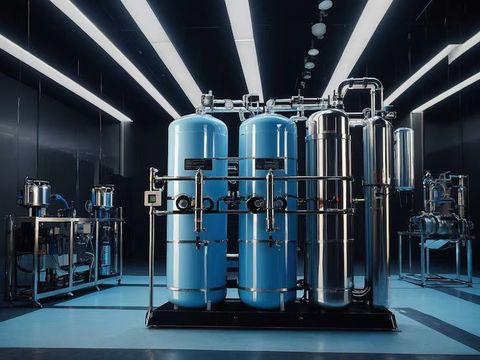
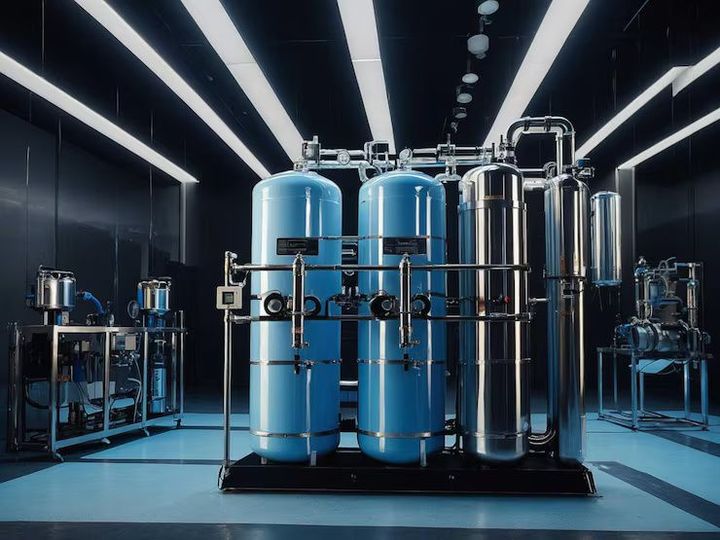
A typical water purification unit can contain several components:
- Sediment filters for reducing suspended particles such as sand, silt, and rust.
- Activated carbon filters for reducing chlorine, certain organic compounds, and substances that can affect taste and odor.
- Ultrafiltration membranes for separating many suspended particles and microorganisms according to membrane characteristics.
- Reverse osmosis membranes for reducing dissolved salts and several other dissolved substances.
- Ultraviolet systems for microbial inactivation.
- Storage tanks for holding treated water before use.
- Pumps, valves, pressure controls, sensors, and monitoring instruments for operating the system.
Not every system requires all of these components. A groundwater system with high dissolved mineral content may require different treatment from a municipal supply that mainly needs particle and chlorine reduction.
Importance
Water quality affects drinking, cooking, hygiene, manufacturing, food preparation, agriculture, and many other activities. Contaminated or unsuitable water can contain microorganisms, suspended matter, excessive dissolved minerals, or chemical substances that make it inappropriate for a particular use.
Water purification units help address these differences by applying treatment methods suited to the characteristics of the incoming water. For households, the focus may be drinking and cooking water. In industrial environments, purification may be related to boilers, cooling systems, manufacturing processes, laboratories, or equipment that requires water with specific characteristics.
Matching Treatment to Water Quality
A key principle in water treatment is that no single purification technology addresses every possible water-quality issue. Testing the source water can help identify which parameters need attention.
For example, sediment filtration is useful when suspended particles are a concern, while reverse osmosis is designed to reduce many dissolved substances. Ultraviolet treatment is primarily concerned with microorganisms rather than dissolved salts.
The following table provides a simplified comparison:
| Purification method | Main purpose | Typical limitation |
|---|---|---|
| Sediment filtration | Reduces suspended particles | Does not address most dissolved substances |
| Activated carbon | Reduces chlorine and some organic compounds | Performance depends on carbon type and water conditions |
| Ultrafiltration | Separates many particles and microorganisms | Does not generally remove dissolved salts |
| Reverse osmosis | Reduces many dissolved salts and contaminants | Produces a concentrated reject stream |
| Ultraviolet treatment | Inactivates microorganisms | Does not remove particles or dissolved chemicals |
| Distillation | Separates water from many dissolved substances | Requires substantial heating energy |
| Ion exchange | Targets selected dissolved ions | Media eventually requires regeneration or replacement |
Everyday and Industrial Applications
Water purification units are used across a wide range of settings. Residential systems may be installed at a point of use, such as a kitchen tap, or at a point where water enters a building.
Commercial and institutional applications can include schools, restaurants, hotels, healthcare facilities, laboratories, and office buildings. Industrial water treatment may involve more complex combinations of filtration, membrane systems, chemical treatment, and monitoring equipment.
The treatment objective can also differ. Drinking water treatment emphasizes suitability for human consumption, while industrial systems may focus on reducing scale formation, protecting equipment, maintaining process conditions, or meeting manufacturing requirements.
Recent Updates
Water purification has continued to move toward more precise treatment, improved monitoring, membrane-based processes, and greater attention to resource efficiency during 2024–2026. Modern systems increasingly combine multiple treatment stages rather than depending on one technology for all water-quality requirements.
Digital monitoring is also becoming more common. Sensors can measure parameters such as pressure, flow, conductivity, turbidity, temperature, or other water-quality indicators depending on the system. Monitoring can help operators identify changes in incoming water and determine when treatment components require attention.
Membrane-Based Treatment
Membrane technologies such as ultrafiltration, nanofiltration, and reverse osmosis remain important in water treatment. Improvements in membrane materials and system design are associated with efforts to manage energy consumption, fouling, water recovery, and treatment performance.
Reverse osmosis remains particularly relevant when dissolved salts and total dissolved solids are a significant concern. However, membrane selection depends on feed-water characteristics and the required treated-water quality.
Ultraviolet and Point-of-Use Systems
Ultraviolet-based drinking-water disinfection has also received attention through standards development. BIS lists IS 14724:2025 for ultraviolet-based point-of-use water disinfection systems intended for drinking purposes.
This reflects a broader movement toward defining performance and safety requirements for specific water-treatment technologies. Such standards help describe technical characteristics and testing requirements rather than implying that one treatment approach is appropriate for every water source.
Packaging and Water Quality Standards
India has also updated standards associated with packaged water during this period. BIS records the third revision of IS 14543 for packaged drinking water and IS 13428:2024 for packaged natural mineral water.
BIS also revised IS 15410:2025 concerning plastic bottles and containers used for packaged natural mineral water and packaged drinking water. The implementation date stated in the BIS circular was September 2025.
These developments illustrate the wider focus on water quality, testing, packaging materials, and conformity with applicable standards.
Laws or Policies
In India, drinking-water quality is addressed through Indian Standards and government programmes. BIS identifies IS 10500 as the specification for drinking water intended for human consumption, covering requirements as well as sampling and testing methods.
For packaged drinking water, BIS materials refer to IS 14543, while natural mineral water is covered by IS 13428. Applicable regulatory requirements can depend on the type of water, treatment facility, product, and intended use.
Drinking Water Supply Standards
BIS also provides a certification framework for piped drinking-water supply management systems under IS 17482:2020. The framework addresses areas including water treatment, storage, distribution, monitoring systems, and emergency planning, with reference to drinking-water specifications.
Government programmes such as Jal Jeevan Mission have also increased attention to household tap-water supply and water-quality management. The regulatory environment can involve multiple authorities, so requirements may vary according to the application and location.
Product Certification
BIS explains that certification is generally voluntary unless the Central Government makes compliance compulsory through applicable regulations or Quality Control Orders.
Certain water-related products have been brought under compulsory certification requirements. For example, BIS reported that drinking water coolers were covered by the Self-Contained Drinking Water Cooler (Quality Control) Order, 2024, with conformity to the applicable Indian Standard required under the order.
Anyone operating or specifying a water purification unit should therefore distinguish between general treatment equipment and products or activities subject to specific regulatory requirements. Applicable standards and rules can change, so current government and standards-body information should be checked for a particular application.
Tools and Resources
Several resources can help readers understand water purification units and water quality.
Water Testing Resources
Water testing laboratories can measure parameters such as pH, turbidity, electrical conductivity, hardness, dissolved solids, microbial indicators, and selected chemical substances. The appropriate tests depend on the source and intended use of the water.
BIS maintains information about laboratories and testing facilities associated with Indian Standards. Its laboratory information system can be used to review testing capabilities for specific standards.
Standards and Reference Materials
The Bureau of Indian Standards website provides information about Indian Standards, conformity assessment, product certification, and testing facilities. These resources can help readers identify applicable standards for drinking water and water-related products.
For household or building-level assessment, water-quality reports from the relevant water utility can also provide useful background. In areas using groundwater, laboratory testing can provide information that may not be available from municipal supply data.
Maintenance and Monitoring Tools
Common monitoring tools include:
- TDS or conductivity meters for assessing dissolved-ion-related changes.
- Turbidity meters for measuring water clarity.
- Pressure gauges for checking filtration-system pressure.
- Flow meters for monitoring water movement.
- pH meters for measuring acidity or alkalinity.
- Filter-life indicators where supported by the equipment design.
- Laboratory test kits for selected water-quality parameters.
These tools have different levels of accuracy and should not automatically be treated as substitutes for laboratory analysis when detailed water-quality assessment is required.
FAQs
What are water purification units?
Water purification units are systems that treat water to reduce specific unwanted particles, microorganisms, dissolved substances, or other contaminants. Their configuration depends on the source-water characteristics and intended use.
Which filtration methods are used in water purification units?
Common filtration methods include sediment filtration, activated carbon filtration, ultrafiltration, nanofiltration, reverse osmosis, and ultraviolet treatment. A system may combine several methods when different types of water-quality issues need to be addressed.
How does reverse osmosis work in a water purification unit?
Reverse osmosis uses pressure to move water through a semipermeable membrane. The membrane can reduce many dissolved salts and other substances, while the concentrated portion is separated from the treated-water stream.
Are ultraviolet water purification systems suitable for all water?
Ultraviolet treatment is primarily used for microbial inactivation. It does not remove dissolved salts, many chemicals, or suspended particles, so pretreatment may be necessary when those substances are present.
What should be considered when selecting a water purification unit?
Important considerations include source-water quality, required treated-water quality, flow rate, daily water demand, contaminant type, available space, electricity requirements, maintenance needs, wastewater generation, and applicable standards.
Conclusion
Water purification units use different technologies to address different water-quality requirements. Sediment filters, activated carbon, membrane systems, reverse osmosis, ultraviolet treatment, and other methods each have specific functions and limitations. Current developments increasingly emphasize combined treatment, monitoring, membrane technology, and clearer standards for water-related equipment. In India, drinking-water quality and relevant products are addressed through BIS standards and applicable government regulations.