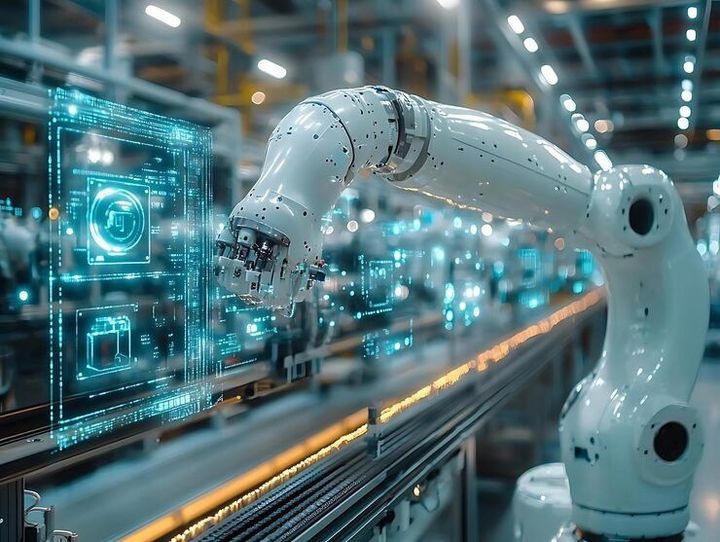
Industrial Physical AI Robots Guide: Working Principles, Capabilities, Uses and Future Developments
Industrial Physical AI robots combine artificial intelligence (AI) with machines that can sense, move, and interact with physical objects in industrial environments. Unlike software-based AI, which mainly processes digital information, physical AI operates through robots, sensors, cameras, actuators, and control systems. These technologies allow machines to interpret their surroundings and perform tasks that involve real-world movement.
Context
Industrial Physical AI robots combine artificial intelligence (AI) with machines that can sense, move, and interact with physical objects in industrial environments. Unlike software-based AI, which mainly processes digital information, physical AI operates through robots, sensors, cameras, actuators, and control systems. These technologies allow machines to interpret their surroundings and perform tasks that involve real-world movement.
Industrial robotics developed from automated production equipment used for repetitive manufacturing operations. Traditional industrial robots generally follow programmed movements in controlled environments. Advances in machine learning, computer vision, simulation, and computing have expanded this approach, enabling some robots to respond to changing conditions rather than relying entirely on fixed instructions.
Physical AI robots can include robotic arms, autonomous mobile robots, collaborative robots, and humanoid robots designed for industrial tasks. Their capabilities depend on their hardware, training data, software, and operating environment. They do not all possess the same level of independence or ability to adapt.
How Industrial Physical AI Robots Work
A physical AI robot uses several connected systems to observe its environment, interpret information, select an action, and control movement. Cameras may identify objects, while proximity sensors, force sensors, and other instruments provide information about distance, contact, and movement.
A typical operating sequence includes:
Perception: Cameras and sensors collect information about objects, equipment, and surroundings.
Interpretation: AI models analyze the information to identify objects, recognize patterns, or estimate positions.
Planning: Control software determines an appropriate sequence of actions within defined operating limits.
Movement: Motors, actuators, and robotic mechanisms carry out the selected action.
Feedback: Sensors measure the result, allowing the control system to adjust movement when necessary.
This process can repeat continuously during a task. However, the robot's ability to respond depends on processing speed, sensor quality, mechanical limitations, and the reliability of its software.
Importance
Industrial Physical AI robots matter because factories, warehouses, and processing facilities often require precise movements, consistent production, and coordination between different machines. Traditional automation can perform predictable tasks effectively, but changing product shapes, variable object positions, and unfamiliar conditions can require additional programming or human intervention.
Physical AI may help address these challenges by combining perception with adaptable control. For example, a robot equipped with computer vision may identify components presented in different orientations and adjust its movements to handle them. Such capabilities can reduce the need for perfectly identical object placement, although performance still depends on the task and environment.
Industrial Applications and Practical Uses
Physical AI robots are being explored across several industrial sectors.
Manufacturing: Robotic systems can support component assembly, machine tending, inspection, material placement, and handling operations.
Warehousing: Autonomous mobile robots can transport materials, navigate designated routes, and coordinate with inventory systems.
Automotive production: AI-assisted robots can help with inspection, component positioning, and selected assembly activities.
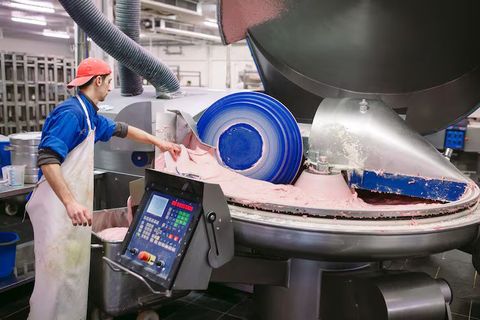
Food processing: Vision-guided machines can identify, sort, or handle products with varying shapes, subject to hygiene and safety requirements.
Mining and heavy industry: Robotic equipment can support remote inspection, material movement, and work in environments that present risks to personnel.
Electronics manufacturing: Precision robotic systems can position small components and assist with visual inspection.
The suitability of a robot depends on the required accuracy, speed, environmental conditions, and consequences of a mistake. Some applications operate with limited supervision, while others require frequent human checks.
Comparing Traditional Robots and Physical AI Robots
| Feature | Traditional industrial robots | Physical AI robots |
|---|---|---|
| Task execution | Often follows predefined programs | May adapt actions using AI models |
| Object recognition | May use dedicated sensors or vision rules | Can use AI-based visual recognition |
| Response to variation | Often requires reprogramming | May handle some variations within training limits |
| Operating environment | Commonly structured and controlled | Can be designed for more variable settings |
| Human oversight | Depends on application and risk | Still required according to task and risk |
| Main limitations | Programming flexibility and setup | Data quality, model reliability, computing, and safety |
These categories overlap. Traditional industrial robots can incorporate AI vision and adaptive controls, while a physical AI robot may still rely on conventional programmed movements for important operations.
Recent Updates
Developments from 2024 through 2026 have brought greater attention to AI models that connect perception, reasoning, and physical action. The industrial robotics field is exploring systems that learn from demonstrations, simulated environments, sensor data, and recorded robot movements. Progress differs across applications, and research demonstrations do not necessarily indicate readiness for continuous factory operation.
Vision-Language-Action Models
Vision-language-action models combine visual information, language instructions, and movement-related outputs. They are being studied as a way to let robots interpret instructions such as identifying a component and moving it to a designated location.
These models may reduce the need to create every action through manual programming. However, they can still misinterpret instructions, struggle with unfamiliar objects, or produce unsuitable movements. Industrial use therefore requires testing, defined operating limits, and independent safety controls.
Simulation and Digital Twins
Simulation allows engineers to test robot movements in virtual environments before deploying them on physical equipment. Digital twins represent industrial machines, production lines, or facilities in digital form and can support planning, monitoring, and analysis.
Simulated training can expose robots to different object positions, lighting conditions, and task sequences. Nevertheless, a simulation may not reproduce every physical detail, including friction, wear, unexpected contact, or sensor noise. Physical testing remains necessary before a system is used in production.
Humanoid and Mobile Industrial Robots
Humanoid robots have received increased attention for their potential to work with equipment and tools designed around human movement. Mobile robots are also being developed to navigate industrial facilities and transport materials between work areas.
These systems face practical challenges involving battery life, payload capacity, balance, navigation, maintenance, and dependable task completion. In many facilities, specialized robotic arms and mobile platforms remain more suitable for narrowly defined operations than general-purpose humanoid machines.
Laws or Policies
Industrial Physical AI robots are affected by workplace safety laws, machinery requirements, electrical standards, data-protection rules, and regulations governing industrial operations. Requirements depend on the country, the robot's design, its intended use, and whether people work nearby.
Industrial Robot Safety in India
In India, industrial robot deployment must be considered within the applicable occupational safety, factory, machinery, electrical, and fire-safety framework. The Occupational Safety, Health and Working Conditions Code, 2020, forms part of India's labour-law framework, with implementation and applicable provisions depending on current government notifications and the relevant establishment.
Factories may also need to comply with applicable state rules, electrical requirements, and machinery-specific standards. The precise obligations depend on the facility and the equipment involved.
Risk Assessment and International Standards
International standards provide technical guidance for designing, integrating, and operating industrial robots. ISO 10218 addresses industrial robot safety, while ISO/TS 15066 provides guidance relevant to collaborative industrial robot applications.
Risk assessment may consider unexpected movement, crushing hazards, collision risks, electrical faults, access to hazardous areas, and system failure. Measures can include physical guarding, safety-rated sensors, emergency stops, controlled operating zones, and appropriate worker training. AI functions do not automatically replace established safety mechanisms.
Data and Cybersecurity Considerations
Physical AI robots may process camera images, production records, machine data, and information from connected systems. Organizations should manage access permissions, software updates, network security, and data retention according to applicable rules and operational requirements.
Connected robots may introduce cybersecurity risks if attackers gain access to control networks or compromise software components. Separating critical control systems from less-trusted networks, monitoring access, and maintaining recovery procedures can help reduce exposure.
Tools and Resources
Engineers, students, and industrial planners can use several resources to understand, simulate, and assess physical AI robotics. The appropriate tool depends on whether the goal is education, programming, system integration, or production deployment.
Robotics Development Platforms
ROS 2: An open-source framework used to develop robotic applications, coordinate software components, and process sensor information.
NVIDIA Isaac Sim: A robotics simulation environment used for virtual testing, synthetic data generation, and development workflows.
Gazebo: A robotics simulator used to model environments, sensors, and robot interactions.
MoveIt: A robotics software framework commonly used for motion planning and manipulation with robotic arms.
These platforms support different workflows and have varying hardware, software, and integration requirements. Their availability does not mean a robot developed with them is automatically suitable for industrial operation.
Planning and Evaluation Resources
Industrial teams can use task checklists, cycle-time measurements, risk-assessment templates, and maintenance records to evaluate a proposed robot installation. Useful measurements include task completion accuracy, cycle time, unplanned stoppages, recovery frequency, energy consumption, and human intervention requirements.
Relevant standards organizations and government workplace-safety authorities can provide guidance on equipment requirements and risk management. Manufacturers' technical documentation can also clarify payload limits, operating temperatures, sensor capabilities, and supported safety features.
FAQs
What are industrial Physical AI robots?
Industrial Physical AI robots are machines that combine physical movement with AI-based perception and decision-making. They can use sensors and software to respond to objects and changing conditions within defined limits.
How do Physical AI robots work in manufacturing?
They collect information through cameras and sensors, interpret their surroundings, plan actions, and control mechanical movement. Feedback helps them adjust actions when conditions change.
What are the main uses of industrial Physical AI robots?
Applications include assembly, machine tending, visual inspection, warehouse transport, material handling, and selected mining operations. Suitability depends on the task, equipment, environment, and safety requirements.
Are humanoid robots ready for factory use?
Some humanoid robots are being tested or deployed in limited industrial settings, but capabilities vary considerably. Reliability, safety, payload, battery life, and operating efficiency remain important evaluation factors.
What safety standards apply to industrial AI robots?
Relevant requirements may include applicable Indian workplace and machinery rules, along with international standards such as ISO 10218. The standards and legal obligations depend on the robot, application, and installation.
Conclusion
Industrial Physical AI robots combine sensing, AI-based interpretation, planning, and physical movement to perform tasks in manufacturing and other industrial environments. Their applications range from robotic assembly and inspection to mobile material handling and experimental humanoid systems. Recent developments in AI models and simulation are expanding their potential, but reliability, cybersecurity, and workplace safety remain essential considerations. Their practical role depends on the task, operating conditions, technical capabilities, and applicable regulations.