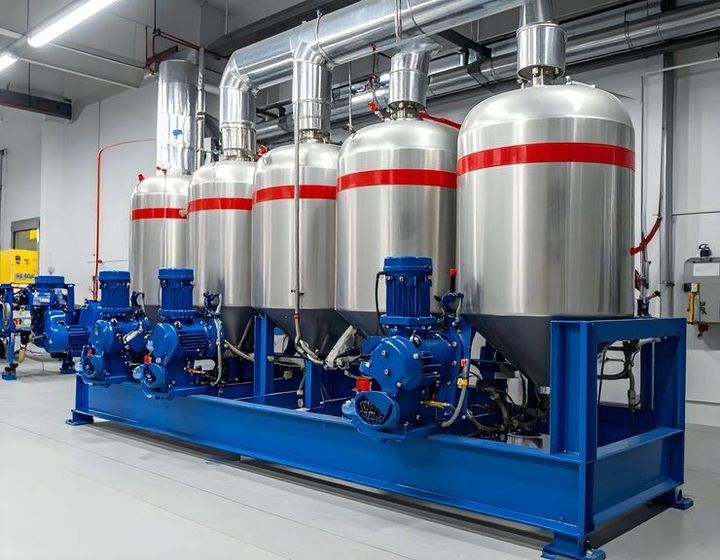
Industrial Filter Press Systems Guide: Designs, Filtration Methods, Uses and Key Considerations
Industrial filter press systems are mechanical filtration units used to separate solid particles from liquids. They are commonly found in wastewater treatment, chemical processing, mining, food processing, pharmaceutical manufacturing, and other industrial environments where suspended solids need to be removed from a liquid stream. A filter press works by pushing a liquid-solid mixture through a series of filter chambers that retain solids while allowing clarified liquid to pass through.
The basic idea behind filter pressing has existed for many years. Traditional systems relied on manually operated plates, filter cloths, and pressure generated through mechanical equipment. Modern industrial filter press systems have developed into more structured units with hydraulic closing mechanisms, automated plate movement, improved filter fabrics, and control systems.
The filtration process generally begins when a slurry enters the filter press. Pressure moves the liquid through the filter cloth, while solid particles collect inside the chambers and gradually form a filter cake. Once filtration is complete, the equipment is opened and the collected solids are removed.
Basic Components
A typical filter press contains several connected components that work together during filtration:
- Filter plates form individual chambers where solids accumulate.
- Filter cloths provide the filtration surface between plates.
- A frame supports and holds the plates in position.
- A hydraulic or mechanical closing system applies pressure to keep the plates together.
- A feed system moves the slurry into the filtration chambers.
- Filtrate channels direct the separated liquid away from the plates.
- A control system may regulate pressure, timing, plate movement, and other operating functions.
The exact arrangement depends on the application, slurry characteristics, required filtration level, and operating conditions.
Importance
Industrial filter press systems matter because many manufacturing and processing activities generate mixtures containing both liquid and solid materials. Separating these components can help facilities manage wastewater, recover useful process materials, control solids, and prepare liquids for additional treatment stages.
For example, wastewater from an industrial process can contain suspended particles that should be separated before the water moves into another treatment stage. A filter press can concentrate those solids into a relatively compact filter cake while producing a liquid stream with reduced suspended material.
Where Filter Press Systems Are Used
Filter presses are used across several industries because different plate, cloth, pressure, and chamber configurations can accommodate different filtration requirements.
Common applications include:
- Municipal and industrial wastewater treatment
- Mining and mineral processing
- Chemical manufacturing
- Food and beverage processing
- Ceramics and clay processing
- Metal finishing
- Aggregate and construction-material processing
- Pulp and paper production
- Pharmaceutical manufacturing
- Sludge dewatering
The equipment is particularly relevant when a process requires mechanical separation of suspended solids from a liquid rather than relying only on settling or gravity.
Why Filter Cake Matters
During filtration, retained particles gradually form a layer known as filter cake. The characteristics of this cake can influence how effectively the press operates.
A cake containing fine particles may restrict liquid movement more quickly than a cake made from larger particles. Moisture content, particle size, slurry concentration, pressure, filter-cloth characteristics, and filtration time can all affect the resulting cake.
Understanding these factors is important because filtration performance depends on the relationship between the slurry and the equipment rather than on the filter press alone.
Designs and Filtration Methods
Filter press systems are available in several designs. Each design uses a similar basic principle but can differ in plate construction, chamber arrangement, operating method, and degree of automation.
Recessed Chamber Filter Press
A recessed chamber filter press uses plates with recessed areas that form filtration chambers when the plates are closed together. Filter cloths are positioned between the plates.
As slurry enters the chambers, liquid passes through the cloth while solids remain inside. The accumulated solids form filter cakes that occupy the recessed spaces.
Membrane Filter Press
A membrane filter press includes flexible membranes that can be expanded after the initial filtration stage. The membranes apply additional pressure to the filter cake.
This additional pressing stage can reduce the amount of liquid remaining in the cake. The approach is useful when lower cake moisture is an important process requirement.
Plate-and-Frame Filter Press
A plate-and-frame design uses separate plates and frames to create filtration chambers. The frames provide space for the retained solids while filter cloths separate the liquid and solid phases.
This configuration has a long history in industrial filtration and can be adapted to different laboratory and industrial applications.
Automatic Filter Press
Automatic systems can include mechanical plate-shifting equipment, automatic cloth washing, hydraulic controls, and programmed filtration cycles. Automation can reduce the amount of manual handling required during repeated filtration operations.
The level of automation varies considerably between installations and is usually selected according to production requirements and operating conditions.
Common Filtration Methods
Several filtration approaches may be used within industrial filter press systems:
- Pressure filtration uses mechanical pressure to force liquid through the filter medium.
- Cake filtration allows retained particles to form a porous layer that becomes part of the filtration barrier.
- Membrane squeezing applies additional pressure to an established cake.
- Air or gas blowing can be incorporated into some processes to remove additional liquid from the cake.
- Washing introduces liquid through the cake to remove selected dissolved materials.
The appropriate method depends on the physical and chemical properties of the material being processed.
Key Considerations
Selecting and operating an industrial filter press involves several technical factors. A system designed for one slurry may not perform in the same way with another material.
Slurry Characteristics
The concentration, particle size, viscosity, temperature, and chemical properties of the slurry can influence filtration behavior. Fine particles may create a dense cake, while larger particles can form a more permeable structure.
The composition of the liquid is also important because filter-cloth materials and plate components need to be compatible with the process environment.
Pressure and Filtration Time
Pressure affects how liquid moves through the filter cake and cloth. Increasing pressure does not automatically produce the desired result because very high pressure can sometimes compress certain types of cakes and reduce their permeability.
Filtration time is another important variable. A longer cycle may increase solids capture, but the relationship depends on the slurry and equipment design.
Filter Cloth Selection
Filter cloths are available in different materials, weave patterns, and pore characteristics. Their selection depends on the particle size and chemical environment of the application.
Cloth condition also matters. Blocked, damaged, or incorrectly fitted cloths can affect liquid flow and filtration consistency.
Operational Comparison
| Filter Press Design | Main Characteristic | Typical Application |
|---|---|---|
| Recessed chamber | Formed filtration chambers | Sludge and industrial solids |
| Membrane | Additional cake squeezing | Applications requiring lower cake moisture |
| Plate-and-frame | Separate plates and frames | General pressure filtration |
| Automatic | Mechanized operating cycle | Repeated industrial filtration |
| Manual | Greater operator involvement | Smaller or less frequent operations |
These categories can overlap because an industrial system may combine several design features.
Recent Updates
Recent developments in industrial filter press systems have generally focused on automation, monitoring, energy management, filtration control, and improved handling of filter cakes.
Automation and Monitoring
Modern systems can incorporate sensors and programmable controls that monitor operating conditions such as pressure, cycle duration, and plate position. Automated plate movement and cake discharge can reduce manual intervention during repeated filtration cycles.
Digital monitoring can also help operators identify changes in filtration behavior. For example, an unusual pressure pattern may indicate changes in slurry characteristics, cloth condition, or equipment operation.
Improved Water and Sludge Management
Growing attention to water reuse and industrial wastewater management has increased interest in mechanical dewatering technologies. Filter presses can be used as one stage within broader treatment systems where water and solid streams require separate handling.
There is also continued development around reducing residual moisture in filter cakes. Lower moisture can influence the handling, transportation, storage, and subsequent treatment of separated solids.
Process Integration
Filter presses are increasingly considered as part of integrated treatment systems rather than isolated machines. They may operate alongside settling systems, pumps, chemical treatment units, drying equipment, and water-recovery processes.
The current trend is toward more measurable and automated filtration cycles, with equipment selected according to the characteristics of the complete process.
Laws or Policies
In India, industrial filter press systems are commonly connected with environmental requirements concerning wastewater, industrial effluent, sludge, and pollution control. The regulatory framework can involve the Central Pollution Control Board, State Pollution Control Boards, environmental permissions, and industry-specific requirements.
Wastewater and Effluent Rules
Industrial facilities that discharge wastewater may need to comply with applicable environmental standards and permissions. Requirements can vary according to the industry, location, discharge route, and characteristics of the wastewater.
Filter presses may form one part of a treatment system used to manage suspended solids and sludge. The equipment itself does not determine whether an overall treatment system meets a regulatory requirement.
Sludge Handling
Separated filter cake may require appropriate handling depending on its composition. Industrial sludge can contain different materials, including process residues or substances requiring controlled management.
Facilities therefore need to consider applicable Indian environmental rules for waste classification, handling, storage, transportation, and disposal. Specific requirements should be checked with the relevant regulatory authority because they can differ by material and industry.
Tools and Resources
Several resources can help readers understand industrial filter press systems and filtration processes.
Technical Calculation Tools
Common filtration calculations may consider slurry volume, solids concentration, filtration area, cycle duration, pressure, and expected cake characteristics. Engineering spreadsheets can be used to organize these variables and compare operating scenarios.
Regulatory Resources
Useful Indian regulatory resources include the websites and publications of the Central Pollution Control Board and relevant State Pollution Control Boards. These resources provide environmental standards, regulatory information, technical documents, and notices related to industrial pollution management.
Equipment Documentation
Manufacturer technical manuals, filter-cloth specifications, pump documentation, and process diagrams can help users understand how a particular filter press is configured. Equipment documentation should be interpreted according to the actual model and process conditions.
FAQs
What is an industrial filter press system?
An industrial filter press system is a mechanical filtration unit that separates suspended solids from liquids. It uses pressure, filter plates, and filter cloths to form and collect a solid filter cake while allowing filtered liquid to pass through.
How does a filter press work?
A slurry is pumped into enclosed filtration chambers. Liquid passes through the filter cloth, while solid particles remain in the chamber and form a filter cake. After the filtration cycle, the plates are separated and the accumulated cake is removed.
What are the main industrial filter press designs?
Common industrial filter press designs include recessed chamber, membrane, plate-and-frame, automatic, and manual configurations. Their operating characteristics differ according to plate construction, cake handling, pressure application, and automation.
What industries use filter press systems?
Filter press systems are used in wastewater treatment, mining, chemical processing, food processing, ceramics, metal finishing, pulp and paper production, and other industries where liquid-solid separation is required.
What factors affect filter press performance?
Important factors include slurry concentration, particle size, viscosity, temperature, pressure, filtration time, filter-cloth characteristics, and cake structure. Equipment condition and operating procedures can also influence filtration results.
Conclusion
Industrial filter press systems use pressure filtration to separate solids from liquids and produce a concentrated filter cake. Different designs, including recessed chamber, membrane, plate-and-frame, and automated systems, are suited to different process conditions. Current developments emphasize automation, monitoring, water management, and integration with broader treatment processes. Understanding slurry properties, filtration conditions, equipment design, and applicable environmental requirements provides useful context for evaluating how filter presses function in industrial applications.