Explore Spot Welding Machines Overview, Technical Insights, and Practical Knowledge
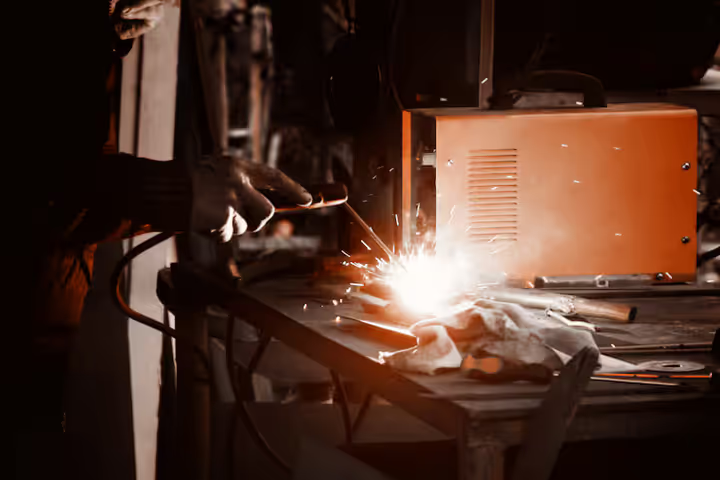
Spot welding machines are a core part of resistance welding technology, widely used in metal joining processes where speed, repeatability, and structural consistency are required. These machines operate by applying electrical current and mechanical pressure to metal sheets, generating heat at the contact point to form a weld nugget.
The concept of spot welding emerged to meet the growing demand for mass production in metal fabrication, particularly in automotive manufacturing and sheet-metal assembly. Traditional joining methods such as riveting or brazing were slower and less consistent, especially when applied to thin metal components. Spot welding machines addressed these limitations by enabling rapid joining with minimal material distortion.
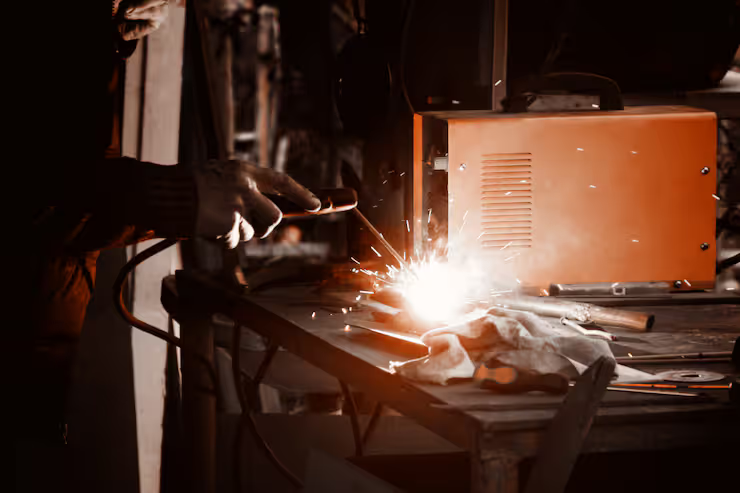
Over time, spot welding technology evolved alongside industrial automation, integrating digital controllers, programmable logic systems, and improved electrode materials. Today, spot welding machines are considered a foundational element of modern manufacturing infrastructure.
Importance: Why Spot Welding Machines Matter Today
Spot welding machines play a crucial role in contemporary industrial ecosystems. Their relevance extends across multiple sectors that rely on efficient, high-volume metal joining processes.
Industries and professionals influenced by spot welding machines include:
-
Automotive body manufacturing and chassis assembly
-
Aerospace component fabrication
-
Electrical appliance manufacturing
-
Industrial machinery production
-
Sheet-metal workshops and fabrication units
The primary problems these machines solve include:
-
Inconsistent weld strength caused by manual joining
-
Excessive heat distortion in thin metal sheets
-
Low productivity in repetitive metal joining tasks
-
Difficulty maintaining quality control in large-scale production
From a manufacturing efficiency standpoint, spot welding machines support:
-
High process repeatability
-
Reduced material waste
-
Lower energy loss compared to arc welding in thin sheets
-
Improved workplace safety through controlled heat application
In an era of smart factories and Industry 4.0 integration, spot welding machines are increasingly embedded into robotic welding cells, enhancing precision and throughput.
Recent Updates: Technology Trends and Developments
The past year has seen notable advancements in spot welding machine design and control systems, reflecting broader trends in industrial digitization.
Key developments observed during 2025 include:
-
Adaptive Welding Control (Q1 2025)
Modern machines now use real-time feedback systems to adjust current, pressure, and weld time dynamically, improving weld consistency across varying material thicknesses. -
Integration with Industrial IoT (Mid-2025)
Spot welding systems are increasingly connected to factory monitoring platforms, enabling predictive maintenance and energy usage analysis. -
Advanced Electrode Materials (Late 2025)
Improved copper alloy electrodes with enhanced thermal conductivity and wear resistance have reduced downtime caused by electrode degradation. -
Energy-Efficient Inverter Technology
Inverter-based spot welding machines are replacing conventional AC systems due to better power factor correction and reduced electrical losses.
These updates reflect a shift toward data-driven manufacturing, where welding quality and equipment performance are continuously optimized.
Laws and Policies Affecting Spot Welding Machines in India
In India, the use and operation of spot welding machines are governed by a combination of industrial safety laws, electrical standards, and manufacturing regulations.
Key regulatory frameworks include:
-
Factories Act, 1948 (India)
Mandates safe operation of industrial machinery, including welding equipment, with provisions for worker protection and electrical safety. -
Bureau of Indian Standards (BIS)
Publishes standards related to resistance welding equipment, electrical insulation, and mechanical safety. -
ISO Welding Standards (Adopted in India)
International standards such as ISO 4063 and ISO 14327 influence welding process classification and quality benchmarks. -
Occupational Safety Guidelines
Regulations emphasize proper grounding, insulation, and operator training to reduce electrical and thermal hazards.
Compliance with these policies ensures that spot welding machines are operated safely and consistently across manufacturing facilities.
Tools and Resources for Spot Welding Knowledge and Analysis
A variety of technical tools and informational resources support understanding and optimization of spot welding machines.
Helpful resources include:
-
Welding current calculation charts for resistance welding
-
Electrode force and pressure reference tables
-
Weld nugget size estimation formulas
-
Industrial automation simulation software
-
Manufacturing quality control documentation templates
Below is a simplified reference table illustrating common welding parameters:
| Material Type | Sheet Thickness (mm) | Typical Current Range (kA) | Weld Time (ms) |
|---|---|---|---|
| Mild Steel | 0.8 – 1.2 | 6 – 9 | 120 – 200 |
| Stainless Steel | 0.6 – 1.0 | 7 – 10 | 100 – 180 |
| Galvanized Steel | 0.7 – 1.2 | 8 – 11 | 140 – 220 |
These tools help engineers and technicians maintain consistent welding quality without excessive trial and error.
FAQs: Common Questions About Spot Welding Machines
What metals are commonly joined using spot welding machines?
Spot welding is most effective for low-carbon steel, stainless steel, and certain aluminum alloys used in sheet-metal applications.
How does spot welding differ from arc welding?
Spot welding uses electrical resistance and pressure, while arc welding relies on an electric arc and filler material to form joints.
Why is electrode material important in spot welding?
Electrode composition affects heat transfer, weld consistency, and electrode lifespan, directly influencing weld quality.
Can spot welding machines be automated?
Yes, many systems are integrated with robotic arms and programmable controllers for automated manufacturing environments.
What factors influence weld strength?
Key factors include electrical current, weld time, electrode pressure, surface cleanliness, and material thickness.
Conclusion: Practical Perspective on Spot Welding Machines
Spot welding machines remain a cornerstone of modern metal fabrication, offering reliable, repeatable, and efficient joining solutions. Their continued evolution reflects broader manufacturing priorities such as automation, energy efficiency, and data-driven quality control.
Understanding the technical principles, regulatory environment, and recent technological advancements enables manufacturers and engineers to apply spot welding more effectively. As industrial processes become increasingly interconnected, spot welding machines will continue to adapt, supporting high-precision production across diverse sectors.