Navratri Silver Bangles Guide: Designs, Styles, Patterns, Materials and Wearing Considerations
Navratri is a major Indian festival associated with devotion, traditional clothing, music, dance, and community celebrations. In Gujarat and several other regions, people commonly participate in Garba and Dandiya Raas while wearing colorful traditional outfits and coordinating jewellery. Silver bangles are one form of hand jewellery that can be worn with these outfits because they combine traditional metalwork with a variety of patterns and shapes.
The history of silver jewellery in India is connected with regional craftsmanship, family traditions, ceremonial clothing, and everyday ornamentation. Silver has been used for bangles, anklets, rings, necklaces, and other ornaments for generations. Designs vary considerably between regions, with differences in engraving, surface texture, motifs, thickness, and finishing techniques.
A Navratri silver bangles guide therefore involves more than appearance. It can include the type of silver, purity marking, bangle construction, size, surface finish, pattern, comfort, and how the jewellery interacts with clothing and movement.
Understanding silver bangles
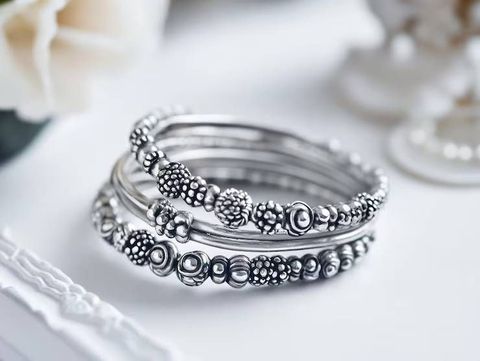
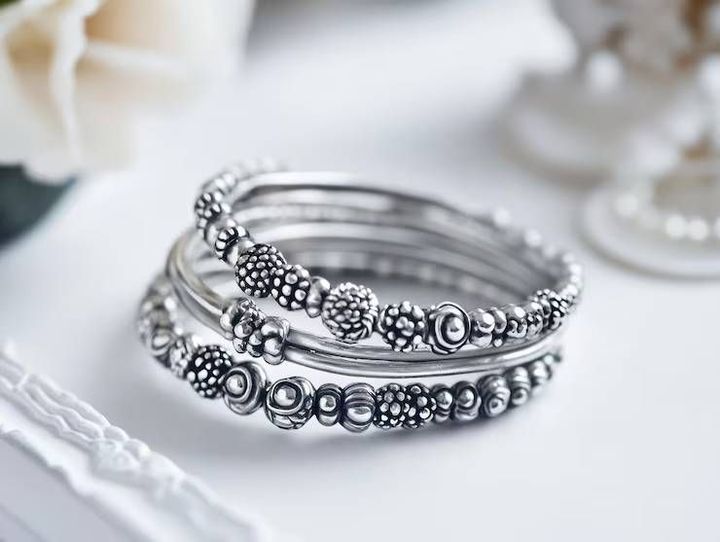
Silver bangles are generally circular or slightly flexible wrist ornaments. Some designs are rigid and slide over the hand, while others have openings, hinges, clasps, or adjustable sections.
Common design characteristics include:
- Plain polished surfaces with minimal decoration
- Engraved floral or geometric patterns
- Oxidized finishes with darker recessed areas
- Hammered or textured surfaces
- Filigree-style details made from fine silver wire
- Traditional motifs inspired by flowers, leaves, paisley shapes, or regional artwork
- Combinations of silver with beads, stones, mirrors, enamel, or colored elements
The term “silver” can describe articles made from different levels of silver purity. A purity number such as 925 indicates the fineness of the metal, meaning 925 parts per thousand are silver. Other recognized grades exist under Indian standards.
Importance
Silver bangles can have cultural, practical, and personal significance during Navratri. For people participating in Garba or Dandiya events, wrist jewellery becomes part of an outfit that may include a chaniya choli, lehenga, kurta, dupatta, or other traditional clothing.
The choice of bangle design can also affect comfort. Garba involves repeated arm and hand movements, so jewellery that is too tight, too loose, excessively heavy, or sharply finished may become inconvenient during extended activity.
Matching designs with traditional clothing
The visual relationship between bangles and clothing depends on color, pattern, fabric, and ornamentation. A heavily decorated outfit may be paired with relatively simple bangles, while a plainer outfit can accommodate more detailed patterns.
For example:
- Mirror-work clothing can be coordinated with textured or oxidized silver patterns.
- Solid-color outfits can work with engraved or patterned bangles.
- Embroidered garments may pair with relatively narrow bangles to avoid excessive visual detail.
- Traditional prints can be accompanied by bangles featuring floral or geometric motifs.
- Minimal outfits can use a small group of similar bangles for a consistent appearance.
Comfort and everyday considerations
Bangle size should allow natural wrist movement without creating excessive pressure. Rigid bangles need an opening large enough to pass over the hand, while adjustable designs require attention to the fit around the wrist.
During dancing, several bangles can move against each other and create sound. Some people enjoy this traditional characteristic, while others may prefer fewer pieces for greater freedom of movement.
Skin sensitivity is another consideration. Silver alloys can contain other metals, and individual reactions can vary. If irritation occurs, removing the jewellery and seeking appropriate professional guidance may be appropriate.
Recent Updates
Silver jewellery has seen several developments in standards and consumer verification in India during 2024–2026. One significant development was the revision of the Indian Standard for silver and silver-alloy jewellery and artefacts. BIS identifies IS 2112:2025 as the revised standard replacing the earlier IS 2112:2014.
HUID-based silver hallmarking
Under the revised IS 2112:2025 framework, HUID-based hallmarking for silver jewellery and articles became voluntary from September 2025. The revised hallmark structure includes the BIS Standard Mark with the word “SILVER,” a purity grade, and a Hallmarking Unique Identification code.
The revised standard specifies seven silver purity grades: 800, 835, 925, 958, 970, 990, and 999. Compared with the earlier standard, 958 and 999 were added while the 900 grade was removed from the revised list.
This development is relevant to silver bangles because consumers may encounter different hallmark formats depending on when an article was hallmarked and which standard applies to it.
Current Navratri styling patterns
Recent Navratri fashion coverage has continued to show combinations of traditional clothing with silver-toned and oxidized hand accessories. Mirror-work, thread-and-bead designs, textured jewellery, and traditional motifs are appearing alongside contemporary outfit combinations. These patterns show that Navratri jewellery can range from traditional forms to more modern interpretations.
The wider trend is toward mixing traditional visual elements with simpler or more contemporary clothing. This allows silver bangles to be used with both strongly decorated garments and relatively minimal outfits.
Laws or Policies
In India, precious-metal hallmarking is administered through the Bureau of Indian Standards (BIS). BIS states that both gold and silver are within the scope of its hallmarking framework, with silver jewellery and artefacts covered by relevant Indian Standards.
Silver purity and hallmarking
The applicable silver standard specifies recognized fineness grades. A hallmark provides information about the precious-metal content represented by the marked fineness. For consumers, this can make it easier to distinguish the stated purity of a silver article from its design or appearance.
The current mandatory hallmarking framework has also been amended several times, including amendments recorded by BIS during 2024, 2025, and 2026. The exact applicability can depend on the article, location, exemptions, and the prevailing notification.
BIS also maintains information about registered jewellers and recognized hallmarking centres. Its consumer guidance explains that articles can be tested through BIS-recognized Assaying and Hallmarking Centres, subject to applicable procedures and charges.
Understanding HUID verification
For applicable hallmarked silver articles carrying the newer HUID format, BIS has described verification through the BIS CARE App. The system can provide details such as article type, purity grade, hallmarking information, and registered jeweller details for relevant articles.
| Silver purity grade | Silver parts per 1,000 | General meaning |
|---|---|---|
| 800 | 800 | 80.0% silver |
| 835 | 835 | 83.5% silver |
| 925 | 925 | 92.5% silver |
| 958 | 958 | 95.8% silver |
| 970 | 970 | 97.0% silver |
| 990 | 990 | 99.0% silver |
| 999 | 999 | 99.9% silver |
These figures describe fineness rather than the complete composition of an article. Additional metals may be present in an alloy, depending on its construction and applicable specification.
Tools and Resources
Several resources can help readers understand silver bangles and related jewellery information without relying only on visual appearance.
BIS CARE App
The BIS CARE App includes tools for checking BIS-related information and verifying HUID details for applicable hallmarked jewellery. It also provides access to standards information and other consumer resources.
BIS hallmarking resources
The BIS website provides information about hallmarking standards, registered jewellers, recognized Assaying and Hallmarking Centres, consumer protection, and relevant regulatory documents. These resources are useful when readers need to understand purity markings or the current hallmarking framework.
Size and measurement tools
A simple measuring tape or wrist-measurement guide can help determine approximate wrist dimensions before considering a bangle. For rigid bangles, hand circumference can also matter because the opening must pass over the widest part of the hand.
Jewellery care references
General jewellery-care references can help explain cleaning, storage, polishing, and tarnish management. Silver can naturally develop surface discoloration over time because of chemical reactions with substances in the surrounding environment. Storage in a dry, enclosed place and avoiding unnecessary contact with chemicals can help maintain its appearance.
FAQs
What designs are common in Navratri silver bangles?
Common Navratri silver bangles designs include plain polished bands, engraved patterns, floral motifs, geometric shapes, oxidized surfaces, hammered textures, and traditional regional patterns. Some designs also incorporate beads, mirrors, enamel, or other decorative elements.
What silver purity is used for silver bangles?
Silver bangles can be made using different silver-alloy grades. Under the revised IS 2112:2025 standard, recognized grades include 800, 835, 925, 958, 970, 990, and 999. The number represents silver fineness in parts per thousand.
How can HUID be checked on silver jewellery?
For applicable silver jewellery carrying the newer HUID-based hallmark, the BIS CARE App can be used to verify relevant hallmark details. The available information can include the article type, purity grade, hallmarking information, Assaying and Hallmarking Centre details, and jeweller registration information.
Are oxidized silver bangles suitable for Navratri outfits?
Oxidized silver bangles are one style that can be combined with traditional Navratri clothing. Their darker surface treatment creates a different visual effect from highly polished silver, making them compatible with garments featuring embroidery, mirror work, or other decorative patterns.
How should silver bangles be cared for?
Silver bangles should generally be kept dry and protected from unnecessary contact with chemicals, perfumes, cosmetics, and household cleaning substances. A soft jewellery cloth can be used for appropriate surface cleaning, while heavily tarnished or intricate pieces may require professional assessment.
Conclusion
Navratri silver bangles combine traditional Indian jewellery practices with a wide range of contemporary and regional designs. Important considerations include silver purity, hallmark information, bangle size, construction, surface finish, comfort, and compatibility with clothing. Recent changes to India’s silver hallmarking framework, particularly the introduction of HUID-based hallmarking under IS 2112:2025, have added another layer of identification and traceability. Understanding these factors provides a clearer basis for interpreting silver bangle designs and markings during Navratri and other cultural occasions.