Hydraulic Control Units Guide: Working Principles, Components, Applications and Selection Factors
Hydraulic control units are assemblies that regulate pressurized fluid so a hydraulic machine can move, lift, clamp, rotate, or hold a load in a controlled way. A typical unit combines a hydraulic pump, reservoir, valves, filters, pressure controls, hoses or passages, and sometimes electronic sensors. Hydraulic control units exist because machines need a practical way to convert fluid pressure and flow into predictable mechanical movement.
Context
How hydraulic control works
A hydraulic control unit normally begins with a reservoir that stores the working fluid. The pump draws fluid from the reservoir and sends it into the circuit. Pressure develops when the fluid encounters resistance from a load or a control element.
Directional valves determine where the fluid travels. Flow-control valves influence movement speed, while pressure-relief valves limit pressure when it reaches a defined level. The controlled fluid then reaches an actuator, such as a hydraulic cylinder or motor, which converts fluid power into linear or rotary motion.
A simple hydraulic control circuit can therefore be understood as four stages: store the fluid, generate flow, regulate the flow and pressure, and convert hydraulic energy into movement. Each stage has a specific role, and the components must work together as one system.
Main components
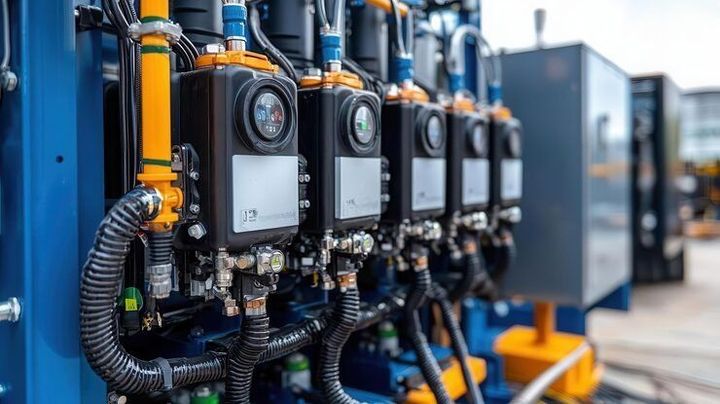
The exact arrangement varies by machine, but a hydraulic control unit commonly includes:
- Reservoir: Holds hydraulic fluid and allows heat and entrained air to separate from the fluid.
- Pump: Produces fluid flow from mechanical input.
- Valves: Direct, regulate, or limit fluid movement and pressure.
- Filters: Capture particles that could interfere with sensitive components.
- Actuators: Convert hydraulic energy into mechanical movement.
- Hoses, pipes, and fittings: Provide fluid pathways between components.
- Pressure gauges and sensors: Provide information about operating conditions.
- Accumulators: Store pressurized fluid for specific operating or energy-management needs.
The selection of each component depends on pressure, flow, temperature, load, operating cycle, fluid type, and the physical space available.
Importance
Hydraulic control units matter because controlled fluid power allows substantial mechanical forces to be managed through compact components. This is useful where a machine must repeatedly lift, press, clamp, steer, tilt, or position a load.
For general users, the technology is usually encountered indirectly. Hydraulic systems can be found in construction equipment, elevators, agricultural machinery, industrial presses, waste-handling equipment, vehicle systems, and automated production equipment.
The main challenges include pressure management, heat generation, fluid contamination, leakage, noise, and accurate motion control. A poorly matched pump, valve, hose, or actuator can affect the behavior of the entire circuit. Contamination is particularly important because particles can accelerate wear and interfere with close-tolerance hydraulic components.
Factors that affect operation
Several operating conditions influence a hydraulic control unit:
- Pressure rating affects the force that an actuator can develop and the safe operating range of components.
- Flow rate influences actuator speed and the amount of hydraulic power transferred.
- Fluid viscosity affects lubrication, leakage, heat generation, and pump operation.
- Temperature changes can alter fluid properties and component behavior.
- Load characteristics determine how the circuit should control acceleration, deceleration, and holding.
- Contamination levels can influence valves, pumps, filters, and seals.
These factors are interconnected. Increasing flow, for example, can increase actuator speed but may also influence heat generation and pressure losses.
Recent Updates
Digital monitoring and electro-hydraulic control
From 2024 through 2026, a notable direction in hydraulic engineering has been greater integration of sensors, electronic controls, and data analysis. Research has examined sensors that monitor pressure, temperature, flow, position, and valve behavior, allowing hydraulic systems to generate more operating information.
Electro-hydraulic control combines hydraulic power with electronic command signals. Proportional and servo valves can adjust fluid flow more precisely than simple on-off control in applications that require controlled movement. Digital control methods are also being studied for energy management, motion control, and automated equipment.
Energy efficiency and condition monitoring
Energy use has become an important design consideration. Current development work increasingly examines variable-speed pumps, improved valve control, energy recovery, compact hydraulic components, and electrified or hybrid machine architectures.
Condition monitoring is another growing area. Sensor data can help identify changes in pressure, temperature, vibration, fluid condition, or component behavior. This supports condition-based maintenance approaches, where equipment condition is considered alongside fixed operating intervals.
Updated standards and technical references
Indian hydraulic-fluid-power standards continue to align with international technical references in several areas. BIS maintains standards covering hydraulic connections, filters, valves, terminology, and related components. Its standards database also provides access to standard information and revisions, making it a useful reference when checking applicable requirements.
Laws or Policies
India
In India, hydraulic control units used in industrial machinery can fall within broader workplace safety and machinery requirements. The Occupational Safety, Health and Working Conditions Code, 2020 defines machinery broadly and includes manufacturing activities involving the generation, transformation, transmission, or control of energy.
Specific requirements depend on the machine, workplace, industry, state-level implementation, and the nature of the equipment. Pressure-related equipment may also be subject to additional rules when it falls within a regulated pressure-vessel or industrial installation category.
Indian Standards
Bureau of Indian Standards publications provide technical references for hydraulic fluid power components. Relevant examples include Indian Standards corresponding to international references for hydraulic connections, filter testing, valve mounting surfaces, and fluid-power terminology.
Standards should be checked according to the actual equipment and application rather than assuming that one document applies to every hydraulic control unit. Manufacturers, machine designers, and facility operators generally need to consider the applicable safety, electrical, pressure, and workplace requirements together.
Tools and Resources
Several resources can help readers understand or evaluate hydraulic control units:
- BIS Know Your Standard: A searchable platform for Indian Standards, amendments, testing information, and related standard records.
- Hydraulic circuit diagrams: ISO-style symbols help readers identify pumps, valves, actuators, filters, and other components.
- Pressure and flow calculations: Basic hydraulic calculators can estimate relationships among pressure, flow, force, displacement, and power.
- Manufacturer component manuals: Technical manuals can provide rated pressure, flow range, temperature limits, fluid compatibility, and installation information.
- Fluid analysis references: Laboratory and technical references can explain particle contamination, viscosity, filtration, and fluid condition.
- Selection checklists: A simple checklist can record operating pressure, required flow, actuator size, duty cycle, temperature, fluid type, connection size, control method, and environmental conditions.
Basic selection checklist
A hydraulic control unit should be considered in relation to the complete hydraulic circuit. Important questions include:
- What load must the actuator move or hold?
- What pressure and flow range does the application require?
- What type of actuator will be used?
- What movement speed and control accuracy are needed?
- What fluid and temperature range are expected?
- What filtration level is appropriate?
- Are electrical sensors or electronic controls required?
- What physical space and connection arrangement are available?
- What safety controls are required for the machine?
- Which Indian Standards or other applicable technical requirements apply?
A written specification helps prevent mismatches between the control unit and the rest of the hydraulic circuit.
FAQs
What is a hydraulic control unit?
A hydraulic control unit is an assembly that manages hydraulic fluid flow and pressure to control an actuator. It commonly includes a pump, valves, reservoir, filtration, pressure controls, and related connections.
How do hydraulic control units work?
Hydraulic control units work by directing pressurized fluid through valves and passages to an actuator. The valves regulate direction, pressure, or flow so the actuator can produce controlled movement.
What are the main hydraulic control unit components?
Common hydraulic control unit components include pumps, reservoirs, directional valves, pressure valves, flow-control valves, filters, actuators, hoses, fittings, gauges, sensors, and sometimes accumulators.
Where are hydraulic control units used?
They are used in construction machinery, industrial presses, agricultural equipment, material-handling systems, manufacturing machines, vehicle systems, and automated equipment where controlled force or movement is required.
What should be considered when selecting a hydraulic control unit?
Selection factors include operating pressure, flow rate, actuator requirements, load, temperature, hydraulic fluid, filtration, duty cycle, control method, connection arrangement, physical space, and applicable safety requirements.
Conclusion
Hydraulic control units provide a structured way to control pressure and fluid flow so machines can produce controlled mechanical movement. Their main elements include pumps, reservoirs, valves, filters, actuators, connections, and monitoring devices. Recent development has placed greater attention on electronic control, sensors, energy management, and condition monitoring. In India, equipment selection also needs to consider relevant workplace rules and applicable Indian Standards.