How Wireless Charging Works for EVs Guide, Insights, Overview, Basics & Practical Knowledge
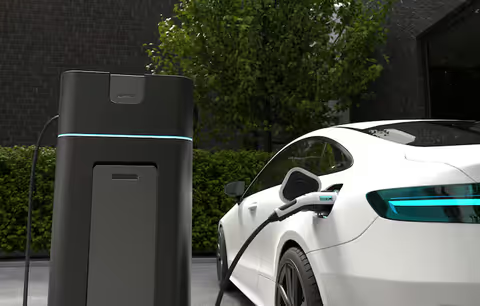
Wireless charging for electric vehicles (EVs) refers to the process of transferring energy from a power source to a vehicle without physical connectors. Instead of plugging in a cable, the system uses electromagnetic fields typically through inductive coupling to transfer electricity between a charging pad on the ground and a receiver installed in the vehicle.
This topic has gained importance in recent years as EV adoption accelerates globally. Governments and manufacturers are exploring ways to simplify charging infrastructure, reduce user friction, and enable new use cases such as autonomous vehicle charging and dynamic (in-motion) charging. Wireless systems aim to eliminate cables, reduce wear and tear, and improve user convenience especially in urban environments and fleet operations.
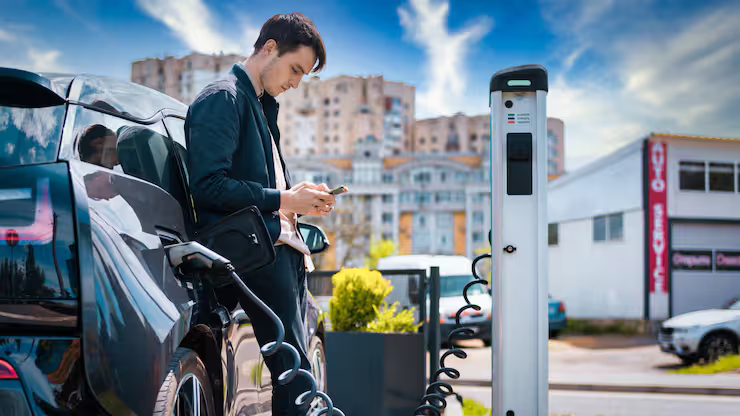
Recent trends show increasing pilot projects, particularly in Europe, the United States, and parts of Asia. Advances in power transfer efficiency, alignment systems, and standardization efforts have brought the technology closer to commercial viability. As EV infrastructure evolves, wireless charging could play a complementary role alongside traditional plug-in systems, especially in high-frequency or automated use scenarios.
Who It Affects and What Problems It Solves
Wireless EV charging affects a wide range of stakeholders, including individual EV owners, commercial fleet operators, urban planners, and automotive manufacturers. For everyday users, it offers convenience removing the need to handle cables, which can be especially beneficial in adverse weather conditions or for people with mobility challenges. For fleet operators, such as taxis, buses, and delivery vehicles, wireless charging enables automated charging cycles, reducing downtime and operational complexity.
Urban infrastructure planners and municipalities also benefit from reduced street clutter, as wireless systems can be embedded into parking spaces or roads. Automotive manufacturers gain opportunities to differentiate vehicles with integrated charging solutions and to support autonomous driving ecosystems.
Problems It Solves
- User Convenience: Eliminates manual plug-in process
- Wear and Tear: Reduces damage to connectors and cables
- Safety: Minimizes risk of electrical hazards from exposed connectors
- Accessibility: Supports users with physical limitations
- Automation: Enables self-charging for autonomous vehicles
- Urban Integration: Reduces visible infrastructure clutter
Wireless charging addresses these challenges by providing a seamless and potentially maintenance-free alternative to traditional charging methods.
Recent Updates and Trends (Past Year)
In the past year, several developments have pushed wireless EV charging closer to mainstream adoption:
- Standardization Efforts: Organizations such as SAE International have continued refining standards like SAE J2954, which defines interoperability between vehicles and charging systems.
- Pilot Projects Expansion: Cities in Europe and Asia have expanded pilot programs for wireless charging roads and taxi stands, testing dynamic charging capabilities.
- Automaker Integration: Some EV manufacturers have begun integrating wireless charging receivers into select models or offering them as optional upgrades.
- Efficiency Improvements: Recent systems have achieved efficiency levels above 90% under optimal alignment conditions, narrowing the gap with wired charging.
- Public Transport Adoption: Electric buses using wireless charging at stops or depots have shown promising results in reducing downtime and improving route efficiency.
These updates indicate that while still emerging, the technology is transitioning from experimental to early commercial stages.
Key Comparison Table: Wireless vs Wired EV Charging
| Feature | Wireless Charging | Wired Charging |
|---|---|---|
| Connection Type | Inductive (no physical contact) | Physical cable connection |
| Convenience | High (automatic) | Moderate (manual plug-in required) |
| Efficiency | ~85–92% (depends on alignment) | ~95–99% |
| Installation Cost | Higher (infrastructure required) | Lower (standard chargers) |
| Maintenance | Lower (fewer moving parts) | Moderate (cable wear possible) |
| Charging Speed | Moderate (currently lower than fast DC) | High (fast DC charging available) |
| Safety | High (enclosed system) | High (with proper use) |
| Scalability | Emerging (limited deployment) | Mature (widely available) |
| Use Cases | Fleets, parking, autonomous systems | All EV users |
Laws, Policies, and Regulatory Landscape
Wireless EV charging is influenced by a range of regulations and government programs, particularly in countries investing heavily in EV infrastructure.
Regulatory Considerations
- Safety Standards: Systems must comply with electromagnetic field (EMF) exposure limits and electrical safety standards.
- Interoperability: Standards like SAE J2954 ensure compatibility between different vehicles and charging systems.
- Infrastructure Approval: Installation of wireless charging pads in public spaces often requires municipal permits and compliance with urban planning guidelines.
Country-Specific Insights (India Context)
In India, EV policies are primarily driven by initiatives such as FAME (Faster Adoption and Manufacturing of Electric Vehicles). While wireless charging is not yet widely included in these programs, the government supports innovation in EV infrastructure, including pilot technologies.
Practical Guidance
- Residential Use: Wireless charging may be suitable for home garages where convenience is prioritized over cost.
- Commercial Fleets: Ideal for taxis, buses, and delivery vehicles with predictable routes and high utilization.
- Public Infrastructure: Best suited for controlled environments like parking lots or transit hubs.
Users should evaluate cost, compatibility, and availability before adopting wireless systems, as infrastructure is still developing.
Tools and Resources
Several tools and resources can help users understand and evaluate wireless EV charging:
Tools and Platforms
- EV Charging Calculators: Estimate charging time and energy consumption
- Simulation Software: Used by engineers to model inductive power transfer systems
- Vehicle Compatibility Checkers: Identify whether a vehicle supports wireless charging
Informational Resources
- Industry reports from organizations like the International Energy Agency (IEA)
- Technical standards documentation (e.g., SAE J2954)
- Academic research papers on inductive charging efficiency and design
Apps and Websites
- EV infrastructure mapping apps (to locate charging stations)
- Manufacturer websites for compatibility and specifications
- Government portals for EV policy updates
These resources support informed decision-making and help users stay updated on technological advancements.
Frequently Asked Questions (FAQ)
What is wireless EV charging and how does it work?
Wireless EV charging uses electromagnetic fields to transfer energy between a ground-based charging pad and a receiver in the vehicle. It relies on inductive coupling, where alternating current creates a magnetic field that induces electricity in the receiver coil.
Is wireless charging as efficient as wired charging?
Wireless charging is slightly less efficient than wired charging, typically achieving 85–92% efficiency compared to 95–99% for wired systems. However, improvements are ongoing.
Can all EVs use wireless charging?
No, only EVs equipped with compatible receiver systems can use wireless charging. Some vehicles may support retrofitting, but compatibility varies.
Is wireless EV charging safe?
Yes, wireless charging systems are designed to meet strict safety standards, including limits on electromagnetic exposure and automatic shut-off mechanisms when foreign objects are detected.
What are the main limitations of wireless EV charging?
Current limitations include higher installation costs, lower charging speeds compared to fast DC chargers, and limited infrastructure availability.
Conclusion
Wireless EV charging represents a promising advancement in electric mobility, offering enhanced convenience, reduced physical interaction, and new possibilities for automation. While current systems show slightly lower efficiency and higher installation costs compared to traditional wired charging, ongoing technological improvements and standardization efforts are narrowing these gaps.
Data from pilot projects and industry studies suggest that wireless charging is particularly effective in controlled environments such as fleet operations and public transport systems, where consistent alignment and usage patterns maximize efficiency. As infrastructure expands and costs decrease, the technology is likely to complement—not replace—wired charging solutions.
For most individual users today, wired charging remains the more practical option due to availability and cost. However, for specific use cases—such as high-utilization fleets or automated systems—wireless charging offers clear advantages.