Robotic Process Control Guide: Technologies, Working Principles, Functions and Industrial Uses
Robotic Process Control is an industrial automation approach that uses robotic equipment, sensors, control systems, and programmed instructions to manage manufacturing and operational activities. It combines robotics with industrial control technologies to perform repetitive tasks, handle materials, monitor production processes, and maintain consistent operating conditions. These systems are used in industries where accuracy, repeatability, production speed, and operational coordination are important.
Context
Robotic Process Control is an industrial automation approach that uses robotic equipment, sensors, control systems, and programmed instructions to manage manufacturing and operational activities. It combines robotics with industrial control technologies to perform repetitive tasks, handle materials, monitor production processes, and maintain consistent operating conditions. These systems are used in industries where accuracy, repeatability, production speed, and operational coordination are important.
The development of robotic process control is connected to the growth of industrial automation. Early manufacturing operations relied heavily on manual controls and mechanical equipment. As electronic controllers, programmable logic controllers (PLCs), industrial computers, and robotic arms developed, factories gained the ability to coordinate multiple machines through automated instructions.
Today, robotic process control can involve individual robotic machines or integrated production systems. These systems may communicate with sensors, conveyors, manufacturing software, and supervisory control platforms to coordinate activities across different stages of production.
Understanding Robotic Process Control Technologies
Robotic process control combines several technologies that perform different functions within an automated environment.
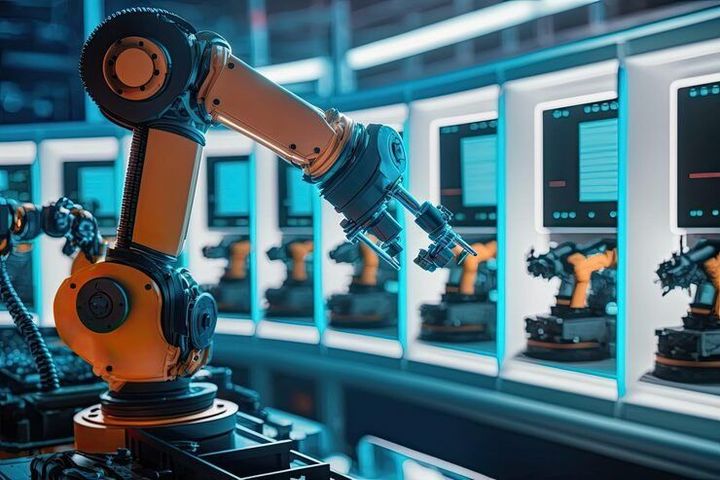
Industrial robots: Programmable machines designed to perform activities such as welding, assembling, painting, packaging, and material handling.
Programmable Logic Controllers (PLCs): Industrial computers that execute programmed instructions and control machinery according to sensor inputs.
Sensors: Devices that detect temperature, pressure, movement, position, distance, and other operating conditions.
Human-Machine Interfaces (HMIs): Interfaces that allow operators to monitor equipment, review information, and adjust approved operating settings.
Supervisory Control and Data Acquisition (SCADA): Systems that collect and display operational information from industrial equipment.
Robotic control software: Programs that define robot movements, operating sequences, task coordination, and equipment responses.
These technologies can operate together or independently, depending on the complexity of the production environment.
Importance
Robotic process control is important because modern industrial operations involve multiple machines, production stages, and operating conditions that require coordination. Manual control can become difficult when factories need to perform repetitive activities across several production lines while maintaining consistent processes.
Automation helps address challenges such as repetitive handling, variations in production, equipment monitoring, and coordination between manufacturing stages. It also allows operators to monitor processes and identify unusual operating conditions through control interfaces and sensor information.
Industrial Problems Addressed by Robotic Control
Robotic process control is used to address several common manufacturing challenges:
Repetitive operations: Robots can perform repeated movements and production tasks according to programmed instructions.
Production consistency: Controlled movements and operating sequences can reduce variations between repeated operations.
Material handling: Robotic systems can move components between workstations, conveyors, and storage areas.
Process monitoring: Sensors and controllers help identify changes in equipment conditions.
Workplace exposure: Robots can perform certain activities in environments involving heat, heavy materials, fumes, or restricted access.
Production coordination: Integrated controllers can synchronize robots, conveyors, and other industrial machines.
Main Functions of Robotic Process Control
The functions of these systems depend on their design and industrial application.
Movement control: Robotic controllers coordinate the movement of mechanical arms, joints, grippers, and other components.
Process sequencing: Controllers execute production steps in a defined order, including starting equipment, moving materials, and completing operations.
Feedback monitoring: Sensors provide information about position, pressure, temperature, speed, and other conditions. Controllers use this information to adjust equipment responses.
Fault detection: Monitoring systems can identify abnormal readings, equipment interruptions, and certain operating errors.
Communication: Industrial networks allow controllers, robots, sensors, and supervisory systems to exchange operational information.
Working Principles of Robotic Process Control
Robotic process control generally follows a repeated cycle involving instructions, sensing, decision-making, and physical action.
Input collection: Sensors detect information about the machine, materials, or surrounding environment.
Data processing: A PLC or robotic controller evaluates incoming information against programmed instructions.
Decision-making: The controller determines whether the system should continue, adjust an operation, or enter a defined safety state.
Mechanical action: Motors, actuators, robotic joints, or other components perform the required movement.
Feedback: Sensors measure the resulting conditions and send updated information to the controller.
This feedback cycle allows automated equipment to respond to changes rather than relying entirely on fixed operating instructions.
Open-Loop and Closed-Loop Control
Two common control approaches are used in industrial automation.
Open-loop control: Equipment performs an operation according to predefined instructions without using feedback to correct the output continuously.
Closed-loop control: Sensors measure the actual output, and the controller adjusts equipment operation according to the difference between the measured condition and the desired condition.
Closed-loop systems are commonly used when operating accuracy and continuous adjustment are important.
| Control approach | Working principle | Common application |
|---|---|---|
| Open-loop control | Executes predefined instructions | Basic conveyor movement |
| Closed-loop control | Uses feedback to adjust operation | Robotic positioning |
| PLC-based control | Executes programmed logic | Production machinery |
| Motion control | Coordinates speed and movement | Robotic arms and CNC equipment |
| Distributed control | Coordinates multiple process controllers | Large industrial facilities |
Recent Updates
Robotic process control continues to develop through improvements in artificial intelligence, industrial networking, sensor technology, and digital manufacturing. Developments from 2024 through 2026 have placed greater attention on connected robotics, predictive maintenance, flexible production systems, and integration between automation equipment and industrial software.
Artificial Intelligence and Adaptive Robotics
Artificial intelligence is increasingly being incorporated into industrial robotics for tasks involving object recognition, visual inspection, pattern identification, and production analysis. Machine vision systems can examine components and identify certain defects or positioning differences.
AI-assisted robotics can also help systems respond to changes in material orientation or production conditions. However, these capabilities depend on the available sensors, training data, operating environment, and system configuration. Not every industrial robot includes adaptive AI functions.
Collaborative Robots and Flexible Manufacturing
Collaborative robots, commonly called cobots, are designed for applications where robots and people may work within a shared workspace under specified safety conditions. They can support activities such as component assembly, inspection, packaging, and material handling.
Flexible manufacturing is another important development. Production systems increasingly use programmable robots and modular equipment that can be adjusted for different product configurations. This allows manufacturers to modify certain production activities without completely redesigning their facilities.
Industrial Internet of Things and Predictive Maintenance
The Industrial Internet of Things (IIoT) connects sensors, machines, controllers, and industrial software through communication networks. This allows operational information to be collected and analyzed across manufacturing environments.
Predictive maintenance systems examine equipment information, including vibration, temperature, operating hours, and performance changes. These measurements can help maintenance teams identify possible equipment problems before they interrupt production. The accuracy of such assessments depends on sensor quality and the analytical methods used.
Laws or Policies
Robotic process control is influenced by industrial safety regulations, machinery requirements, electrical standards, workplace rules, and cybersecurity considerations. In India, manufacturers and industrial operators must consider applicable central and state regulations when introducing automated equipment into production environments.
Industrial Safety Regulations in India
The Occupational Safety, Health and Working Conditions Code, 2020, forms part of India's framework for workplace health and safety. Its implementation and applicable provisions should be considered alongside relevant rules and notifications.
Factories and industrial establishments must also consider applicable requirements under the Factories Act, 1948, and associated state rules, depending on the establishment and the legal provisions in force.
Industrial robot installations may involve safety measures such as:
Physical guards and restricted operating areas.
Emergency stop mechanisms.
Safety interlocks and protective sensors.
Defined operating procedures.
Appropriate worker training.
Regular inspection and equipment maintenance.
These measures help address risks involving unexpected movement, mechanical contact, electrical equipment, and automated machinery.
Machinery Standards and Cybersecurity
The Bureau of Indian Standards (BIS) develops and publishes Indian Standards covering different engineering and industrial applications. Relevant international standards may also be considered when designing and integrating robotic systems.
For example, ISO 10218 addresses industrial robot safety, while ISO/TS 15066 provides additional guidance concerning collaborative robot applications.
Cybersecurity is another consideration because connected industrial controllers may communicate through factory networks and external systems. Access controls, network segmentation, software updates, monitoring, and backup procedures can help reduce operational risks.
Tools and Resources
Several engineering tools and industrial platforms are used to design, program, simulate, and monitor robotic process control systems. Their suitability depends on the equipment, production requirements, and technical environment.
Robot Programming and Simulation Software
Robot simulation software allows engineers to model robotic movements and examine production layouts before physical installation. These tools can help identify movement restrictions, workspace conflicts, and possible equipment interactions.
Examples include:
ABB RobotStudio: Used for programming, simulation, and visualization of ABB robotic systems.
FANUC ROBOGUIDE: Used to simulate and plan applications involving FANUC industrial robots.
Siemens TIA Portal: Used for configuring and programming industrial automation equipment, including PLCs and HMIs.
RoboDK: A robot simulation and programming platform that supports different industrial robot models.
Industrial Monitoring and Control Platforms
SCADA and industrial control platforms help operators monitor machinery and review production information. These systems may display equipment status, process measurements, alarms, and operational trends.
Industrial data platforms can also support maintenance planning and production analysis. Their integration requirements depend on the communication protocols, controller models, and network architecture used by the facility.
Resources for Learning Industrial Robotics
People studying robotic process control can explore technical documentation, industrial automation standards, engineering textbooks, and manufacturer programming guides.
Useful learning subjects include:
PLC programming and industrial logic.
Robot coordinate systems and motion control.
Sensor integration and machine vision.
Industrial communication protocols.
SCADA and HMI configuration.
Machinery safety and risk assessment.
Understanding these areas provides a foundation for interpreting how automated production systems operate.
FAQs
What is robotic process control?
Robotic process control is an industrial automation approach that combines robots, controllers, sensors, and programmed instructions to manage manufacturing and operational activities. It supports automated movement, monitoring, sequencing, and process coordination.
How does robotic process control work?
It works through a cycle of collecting sensor information, processing data, executing programmed decisions, and controlling mechanical equipment. Feedback allows the system to monitor results and adjust operations when required.
What technologies are used in robotic process control?
Common technologies include industrial robots, PLCs, sensors, HMIs, SCADA platforms, machine vision, motion controllers, and industrial communication networks.
What are the main industrial uses of robotic process control?
Common applications include automotive assembly, welding, packaging, electronics manufacturing, material handling, painting, inspection, and warehouse operations.
What is the difference between robotic process control and traditional automation?
Traditional automation may use fixed mechanical equipment, conveyors, and programmable controllers to perform specific operations. Robotic process control incorporates programmable robotic movements and feedback systems to coordinate more flexible physical tasks.
Conclusion
Robotic process control combines industrial robots, sensors, controllers, and software to coordinate automated production activities. Its working principles involve programmed instructions, sensor feedback, mechanical movement, and continuous monitoring. Developments in AI, collaborative robotics, and industrial connectivity are expanding its applications across manufacturing environments. Industrial safety standards, cybersecurity practices, and appropriate system integration remain important considerations.