Explore Boring Machines Informative Overview, Working Details, and Knowledge
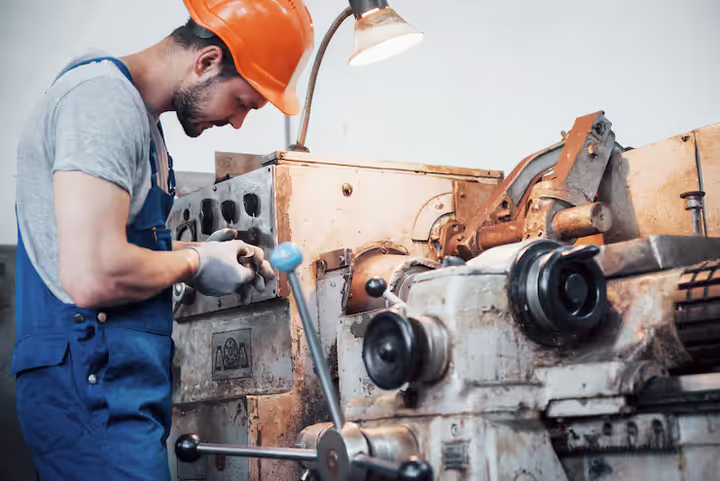
Boring machines are industrial machines designed to enlarge, align, or refine existing holes with high accuracy. Unlike drilling, which creates a hole from solid material, boring improves the geometry, straightness, diameter, and surface finish of an already formed hole. These machines play a critical role across manufacturing, construction, aerospace, automotive, power generation, and infrastructure development.
The concept of boring evolved alongside metalworking and mechanical engineering. Early versions were manually operated, using hand-held bars and simple rotating tools. With the industrial revolution, boring machines became motor-driven, enabling consistent precision for steam engines, heavy equipment, and structural components. Today, CNC-controlled boring machines integrate digital control, automation, and real-time monitoring to meet complex production requirements.
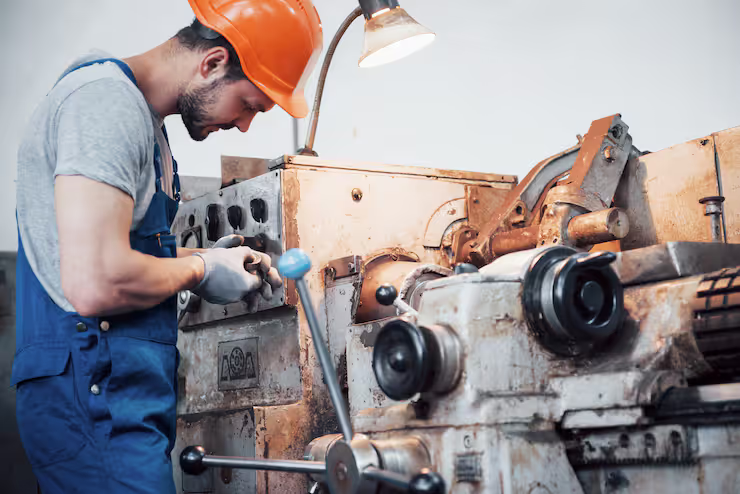
Common categories include:
-
Horizontal Boring Machines
-
Vertical Boring Machines
-
Precision Jig Boring Machines
-
Tunnel Boring Machines (TBMs) for underground excavation
Each type exists to meet specific structural, dimensional, and operational needs in modern industry.
Why Boring Machines Matter Today
Boring machines are foundational to high-precision manufacturing and large-scale infrastructure development. Their importance has grown as industries demand tighter tolerances, improved surface quality, and consistent repeatability.
Industries directly affected include:
-
Automotive and heavy vehicle manufacturing
-
Aerospace and defense engineering
-
Power plant equipment fabrication
-
Oil and gas machinery production
-
Underground transport and metro construction
The problems boring machines help solve include:
-
Dimensional Inaccuracy: Ensuring accurate bore diameter and alignment
-
Poor Surface Finish: Producing smooth, high-quality internal surfaces
-
Structural Weakness: Creating properly aligned load-bearing holes
-
Assembly Errors: Preventing misfit of shafts, bearings, and housings
From an economic and technical standpoint, boring machines reduce material waste, increase component longevity, and enhance system reliability. In large tunnel projects, tunnel boring machines drastically reduce excavation risks while improving worker safety and project efficiency.
Recent Updates and Industry Trends (2024–2025)
The past year has seen notable advancements in boring machine technology driven by digital manufacturing, sustainability goals, and infrastructure expansion.
Key 2024–2025 Developments:
-
AI-Based Tool Monitoring (2024): Machine tool manufacturers introduced AI-driven tooling diagnostics to detect vibration, load fluctuation, and tool wear in real time.
-
Smart CNC Integration (Mid-2024): Advanced CNC boring systems now integrate digital twins and adaptive machining strategies.
-
Electric Tunnel Boring Machines (Late 2024): Electrically powered TBMs are increasingly replacing diesel-powered models to reduce underground emissions.
-
5-Axis Boring Technology Adoption (2025): High-precision 5-axis boring centers are being deployed for complex aerospace components.
-
Infrastructure Expansion Programs (2024–2025): Large-scale metro rail, expressway tunnels, and hydroelectric projects across Asia and Europe have increased demand for advanced boring systems.
Automation Trend Snapshot
| Year | Key Technology Shift | Impact |
|---|---|---|
| 2023 | Automated spindle control | Reduced vibration |
| 2024 | AI predictive maintenance | Lower tool failure rates |
| 2025 | Full digital machining cells | Higher throughput accuracy |
These updates reflect a shift toward intelligent manufacturing and environmentally responsible heavy machinery.
Laws, Regulations, and Government Influence
Boring machines fall under multiple regulatory frameworks due to their industrial nature, power consumption, and safety implications. Regulations differ by country but often follow international safety standards.
Key Regulatory Influences:
-
Occupational Safety Standards: Operator protection, guarding systems, and emergency stops are mandatory under workplace safety laws.
-
Machine Tool Certification: ISO standards such as ISO 23125 cover safety requirements for boring and milling machines.
-
Environmental Compliance: Emission limits apply to tunnel boring operations, especially in urban underground projects.
-
Infrastructure Development Programs: Government-funded highway, metro, and hydropower projects directly shape tunnel boring machine deployment.
In India, large public infrastructure initiatives such as metro rail expansion, river-linking tunnels, and underground utility corridors continue to influence the adoption of tunnel boring equipment. Manufacturing hubs are also guided by national industrial safety frameworks and digital manufacturing policies.
Tools and Resources for Boring Machine Knowledge
Professionals working with boring machines rely on a wide ecosystem of technical aids for design, simulation, measurement, and diagnostics.
Helpful Tools and Resources:
-
CNC Simulation Software: Enables virtual testing of boring operations
-
Tool Life Monitoring Systems: Tracks insert wear and cutting performance
-
Laser Alignment Instruments: Ensures spindle and bore axis accuracy
-
Vibration Analysis Sensors: Detects abnormal machining behavior
-
Engineering Data Portals: Provide machining parameters and material properties
-
Digital Metrology Systems: For bore diameter and cylindricity measurement
Common Measurement Parameters Tracked
| Parameter | Purpose |
|---|---|
| Bore Diameter | Dimensional accuracy |
| Roundness | Shape consistency |
| Surface Roughness | Finish quality |
| Spindle Speed | Machining control |
| Feed Rate | Productivity balance |
These resources improve both quality control and machine lifecycle management in industrial environments.
Working Principles of Boring Machines
At a fundamental level, boring machines operate by rotating a cutting tool that removes material from the inner surface of an existing hole. The workpiece is either stationary or rotates depending on the machine design.
Core Components:
-
Spindle assembly
-
Boring bar and cutting tool
-
Worktable or fixture
-
Drive motor and gearbox
-
CNC control panel (in modern models)
The boring process typically follows these steps:
-
Initial pilot hole preparation
-
Tool positioning and alignment
-
Controlled tool rotation and axial feed
-
Material removal and finishing pass
-
Final dimensional inspection
Precision control of spindle speed, feed rate, and depth of cut ensures consistent accuracy, even for deep or large-diameter bores.
Types of Boring Machines and Their Functions
Below is a functional overview of main boring machine categories:
-
Horizontal Boring Machine: Used for large, heavy workpieces such as engine blocks and gear housings
-
Vertical Boring Machine: Suitable for large-diameter components like turbine casings
-
Jig Boring Machine: Designed for ultra-precise hole positioning
-
Tunnel Boring Machine (TBM): Used for underground excavation of tunnels for transport and utilities
Functional Comparison Table
| Type | Orientation | Primary Use |
|---|---|---|
| Horizontal | Side-mounted spindle | Heavy machinery parts |
| Vertical | Upright spindle | Large circular bores |
| Jig | Multi-axis precision | Tooling & dies |
| TBM | Forward excavation | Underground tunnels |
Performance Factors and Machining Accuracy
The performance of a boring machine depends on several interacting factors:
-
Spindle rigidity
-
Tool material and geometry
-
Machine vibration control
-
Thermal stability
-
Digital control resolution
Modern CNC boring machines utilize adaptive control systems that automatically modify feed and speed based on cutting conditions. This enhances tool lifespan and minimizes dimensional variation.
FAQs About Boring Machines
What is the main difference between drilling and boring?
Drilling creates a new hole in solid material, while boring enlarges and refines an existing hole for accuracy and surface quality.
Are boring machines only used in metalworking?
No. While metal is the primary material, boring machines are also used for composites, polymers, concrete, and rock in tunnel boring applications.
How does CNC improve boring machine performance?
CNC improves repeatability, multi-axis control, tool compensation, and automated accuracy adjustments during machining.
What industries depend most on boring technology?
Automotive, aerospace, power generation, infrastructure construction, and heavy equipment manufacturing depend heavily on boring processes.
How are tunnel boring machines guided underground?
TBMs use laser alignment systems, gyroscopic navigation, and digital mapping to maintain precise tunnel direction and slope.
Future Outlook of Boring Machine Technology
The future of boring machines is being shaped by:
-
Smart factories and connected machining cells
-
Robotics-supported material handling
-
Carbon-neutral excavation systems
-
Cloud-based machine analytics
-
Hybrid additive–subtractive machining centers
These advances are leading toward fully autonomous machining environments where boring machines operate with minimal human intervention while maintaining exceptional accuracy.
Conclusion
Boring machines remain a cornerstone of precision engineering and large-scale infrastructure development. From refining microscopic tolerances in aerospace components to carving massive underground tunnels for metros and utilities, their applications span the full spectrum of modern industry.
Recent technological advancements such as AI-based monitoring, electric tunnel boring systems, and smart CNC integration have significantly improved productivity, safety, and environmental performance. Regulatory frameworks further ensure that boring operations align with workplace safety and sustainability standards.
As digital manufacturing and infrastructure expansion continue to grow worldwide, boring machines will play an even more vital role in shaping industrial reliability, construction efficiency, and engineering excellence. If you would like, I can also provide a dedicated comparison between horizontal, vertical, and tunnel boring machines with application-specific insights.