Noodle Making Machines Guide: Designs, Production Processes, Applications and Maintenance
Noodle making machines are food-processing systems used to turn flour-based dough into strands, sheets, or shaped noodle products. They bring together stages such as mixing, dough forming, sheeting or extrusion, cutting, drying, and packaging. Modern equipment ranges from compact units for smaller production areas to integrated lines for larger food-processing operations.
Context
From manual preparation to mechanized production
Noodles have a long history across East and Southeast Asia, with related wheat, rice, and starch-based products appearing in many food traditions. Traditional preparation involved mixing dough by hand, rolling or stretching it, cutting strands, and drying or cooking them. As demand for consistent shapes and larger production volumes increased, mechanical equipment was developed to repeat these stages with controlled settings.
A noodle production line does not necessarily use one machine for every stage. A basic arrangement may contain a mixer, dough sheeter, and cutter. Instant noodle systems can add steaming or pregelatinization, forming, and dehydration equipment. The exact arrangement depends on the raw material, noodle style, moisture level, shape, and intended cooking method.
Common machine designs
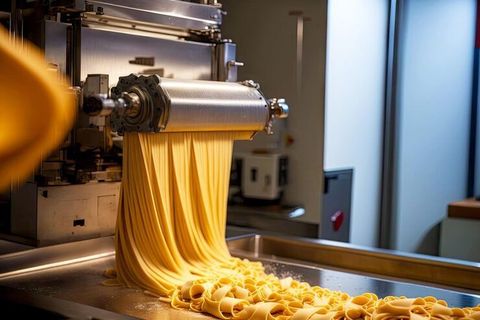
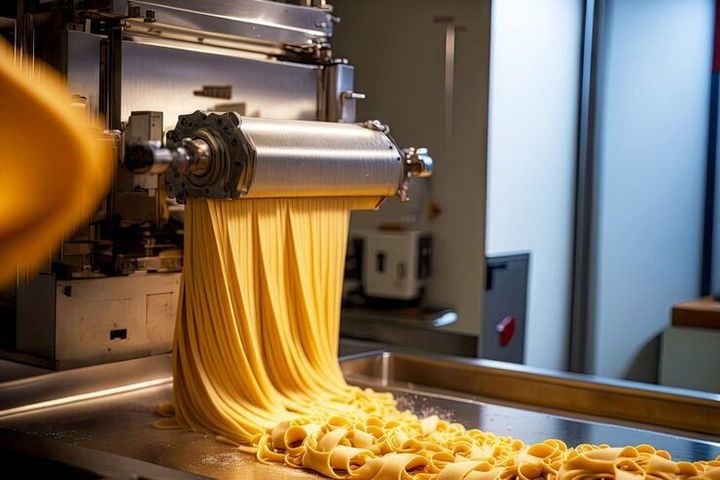
Noodle making machines can be grouped according to how dough is formed and shaped. Sheeting machines pass dough through rollers to create a continuous sheet, which is then cut into strands. Extrusion systems push prepared dough or mixtures through a die to create a selected shape.
Some equipment is designed for fresh noodles, while other lines are configured for dried or instant products. A typical machine may include a hopper or feed area, rollers or an extruder, cutting tools, conveyors, and adjustable controls. Food-contact parts are commonly designed with surfaces that support cleaning and sanitation.
Importance
Why production equipment matters
Noodle manufacturing requires control over several variables at the same time. Flour composition, water addition, mixing, dough resting, sheet thickness, cutting dimensions, drying conditions, and storage can all affect the finished product.
Mechanized production helps make repeated batches more uniform. This can be important for kitchens, food processors, institutional food production, and packaged-food facilities that need predictable portions and shapes.
Noodle making machines also address practical production challenges. Manual shaping can involve substantial repetitive work, while mechanical rollers and cutters can maintain defined widths and thicknesses over longer production runs. Equipment does not remove the need for trained operators; it changes how tasks are performed and monitored.
Main applications
The equipment is used for several noodle categories and production settings:
- Fresh noodles: Machines can mix, sheet, cut, and portion dough for products intended for relatively short storage periods.
- Dried noodles: Formed strands pass through controlled drying stages to reduce moisture and improve storage stability.
- Instant noodles: Production can include steaming or pregelatinization followed by cutting, shaping, and dehydration.
- Rice and specialty noodles: Some lines are designed for rice flour, starch-based mixtures, or combinations of cereals and legumes.
- Institutional production: Larger kitchens and food facilities may use compact automated equipment to prepare consistent quantities.
The suitability of a machine depends on the recipe and product specification. Equipment designed for wheat-based dough may not perform in the same way with high-starch or rice-based formulations.
Key machine stages
| Production stage | Main purpose | Typical equipment |
|---|---|---|
| Mixing | Combine flour, water, and other permitted ingredients | Dough mixer |
| Resting | Allow dough structure to develop | Resting chamber or conveyor |
| Sheeting | Reduce dough to a controlled thickness | Roller sheeter |
| Cutting | Create strands or selected shapes | Noodle cutter |
| Steaming | Partially cook or pregelatinize some products | Steamer |
| Drying | Reduce moisture under controlled conditions | Dryer |
| Portioning | Divide product into consistent units | Portioning unit |
| Packaging | Protect the finished product | Packing equipment |
Recent Updates
Automation and process monitoring
During 2024–2026, food-processing equipment has continued moving toward greater automation and more detailed process monitoring. Noodle lines increasingly use digital control panels, adjustable motor speeds, sensors, and programmable settings to help operators monitor production conditions.
Servo-driven systems and variable-speed controls can provide finer adjustment of rollers, cutters, and conveyors. Some facilities can also record production data for process review and maintenance planning. These developments do not change the basic noodle-making process, but they can make equipment settings easier to monitor.
Flexible product formats
Another general trend is greater flexibility. Producers may need equipment that can handle different noodle widths, shapes, thicknesses, or formulations without rebuilding an entire production line. Interchangeable cutters, adjustable rollers, and configurable extrusion dies can support this type of production.
There is also continued interest in non-fried instant noodles and products made from rice, millets, legumes, and other cereal ingredients. FSSAI maintains product standards covering cereal products and has provisions for instant noodles, including fried and non-fried forms.
Hygiene-focused equipment design
Food-processing equipment design also emphasizes cleanable surfaces, accessible components, controlled water use, and procedures that reduce contamination risks. FSSAI guidance states that licensed food businesses should implement a documented Food Safety Management System and follow applicable hygiene requirements under Schedule 4.
Laws or Policies
Food safety requirements in India
In India, noodle production is covered by the wider food-safety framework established under the Food Safety and Standards Act, 2006. FSSAI regulations cover food-product standards, contaminants, packaging and labelling, licensing, and related areas.
For noodle products, the Food Safety and Standards (Food Products Standards and Food Additives) Regulations include cereal and cereal-product provisions. FSSAI's product-standards resources identify these regulations as a core set of standards, while its consolidated compendium includes the cereal and cereal-products chapter.
Food businesses involved in manufacturing, processing, packaging, storage, or distribution also need to consider applicable licensing and hygiene requirements. FSSAI states that food businesses applying for a licence need a documented FSMS plan and compliance with relevant Schedule 4 requirements.
Packaging and declarations
Packaged noodle products can also be affected by Indian labelling and Legal Metrology requirements. The Department of Consumer Affairs identifies declarations for applicable pre-packaged commodities, including information such as manufacturer or packer details, generic name, net quantity, date-related information where applicable, and consumer-care details.
The Department has also published amendments and proposed changes to the Legal Metrology (Packaged Commodities) Rules in recent years. Manufacturers should therefore consult current official rules and notifications when preparing packaging information.
Food-processing programs
India's Ministry of Food Processing Industries operates programs covering food-processing infrastructure, training, and upgrading of micro food-processing enterprises. The PMFME program includes areas such as infrastructure, capacity building, and upgrading of individual micro food-processing units.
Eligibility, application conditions, and financial provisions can change, so official government program pages should be checked for current requirements.
Tools and Resources
Practical production tools
Several tools can help operators monitor a noodle-making process. A weighing scale helps maintain ingredient ratios, while moisture measurement can help assess dough and finished-product conditions. Thermometers can be used to monitor heating and drying stages where temperature control is part of the process.
Useful resources include:
- FSSAI product standards and food-law pages for applicable food requirements.
- FoSCoS for food-business licensing and regulatory information.
- Ministry of Food Processing Industries resources for food-processing programs and technical guidance.
- Equipment manuals for machine settings, cleaning procedures, lubrication schedules, and replacement-part specifications.
- Production records for tracking batch ingredients, processing settings, cleaning activities, and quality checks.
Machine manuals are particularly important because roller gaps, cutter dimensions, dough-feed rates, and cleaning methods differ between designs. Operating instructions should be followed for the specific equipment rather than copied from an unrelated machine.
FAQs
What is a noodle making machine?
A noodle making machine is equipment that processes dough or a prepared food mixture into noodle sheets, strands, or other shapes. Depending on its design, it may include mixing, sheeting, extrusion, cutting, steaming, drying, or portioning stages.
How does a noodle production process work?
A typical process begins with ingredient measurement and mixing. The dough may then rest before being sheeted or extruded, cut into the required shape, and either cooked, steamed, dried, or otherwise processed according to the product type.
What types of noodle making machines are available?
Common types include dough mixers, roller sheeters, noodle cutters, extrusion machines, steaming equipment, drying systems, and integrated production lines. The appropriate design depends on the noodle formulation and required production process.
What maintenance is needed for noodle making machines?
Routine maintenance can include cleaning food-contact surfaces, checking belts and moving parts, inspecting cutters and rollers, checking fasteners, and following the manufacturer's lubrication schedule. Electrical and mechanical inspections should follow the equipment manual and applicable workplace procedures.
Are noodle making machines regulated in India?
The machines are part of a broader food-processing environment, while the resulting food products are subject to applicable FSSAI requirements. Manufacturing facilities must also consider food-safety, hygiene, packaging, labelling, and Legal Metrology rules relevant to their operations.
Conclusion
Noodle making machines combine mechanical shaping, cutting, cooking or steaming, drying, and handling stages to support different noodle-production methods. Their designs vary according to ingredients, noodle shape, moisture level, and production scale. Current equipment trends emphasize automation, adjustable processing, hygiene, and process monitoring. In India, food manufacturers also need to consider applicable FSSAI, packaging, labelling, and Legal Metrology requirements.

You May Also Like