Explore Grinding Machines Types: Guide, Insights, Tips, and Essential Knowledge
Grinding machines are precision tools used in manufacturing and engineering to remove material from a workpiece through abrasion. Unlike conventional cutting tools, grinding relies on a rotating abrasive wheel that gradually shapes or finishes surfaces with high accuracy. These machines play a critical role in industries such as automotive, aerospace, construction, and tool manufacturing, where tight tolerances and smooth finishes are essential.
In recent years, the comparison of grinding machine types has become increasingly relevant due to rapid advancements in automation, material science, and digital manufacturing. With the rise of CNC (Computer Numerical Control) systems, grinding machines are no longer limited to manual operations they now support highly complex, repeatable, and efficient processes. This shift is influencing production efficiency, cost optimization, and product quality across industries.
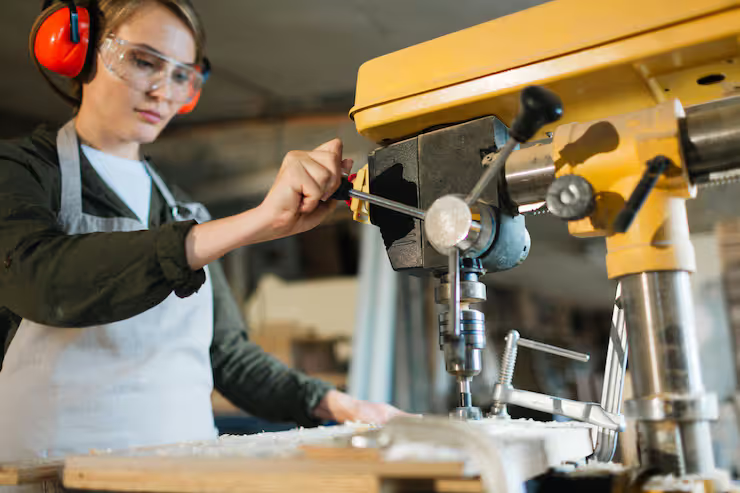
Trends such as smart manufacturing, Industry 4.0 integration, and eco-friendly machining practices are also shaping how grinding machines are designed and used. Understanding the differences between various grinding machine types helps manufacturers, engineers, and students make informed decisions about equipment selection and process optimization.
Who It Affects and What Problems It Solves
Grinding machines affect a wide range of stakeholders, including manufacturing engineers, production managers, machine operators, and even product designers. Industries such as automotive, aerospace, heavy machinery, and electronics rely heavily on grinding processes to achieve precision finishes and meet strict quality standards.
For beginners or small-scale manufacturers, choosing the right type of grinding machine can be challenging due to the variety of options available. Each machine type is designed for specific tasks, materials, and levels of precision. Misalignment between machine capabilities and production needs can lead to inefficiencies, higher costs, and compromised product quality.
Grinding machines solve several critical problems in manufacturing:
- Precision Finishing: They provide extremely smooth and accurate surface finishes that other machining processes cannot achieve.
- Material Hardness Handling: Grinding is ideal for hard materials like hardened steel, ceramics, and alloys that are difficult to machine with traditional tools.
- Dimensional Accuracy: Ensures tight tolerances, which are essential in components like bearings, shafts, and gears.
- Surface Correction: Removes defects, irregularities, and excess material from surfaces.
- Tool Sharpening: Maintains and restores cutting tools, improving their performance and lifespan.
Recent Updates and Trends
Over the past year, several developments have influenced the grinding machine landscape:
- CNC and Automation Expansion: CNC grinding machines continue to dominate due to their precision and ability to automate complex tasks. Integration with robotics is becoming more common in high-volume production environments.
- AI and Predictive Maintenance: Manufacturers are incorporating sensors and AI-based monitoring systems to predict wear and reduce downtime.
- Energy Efficiency Improvements: Newer grinding machines are designed to consume less power and reduce coolant usage, aligning with sustainability goals.
- Hybrid Machines: Machines combining grinding with milling or turning functions are gaining traction, reducing the need for multiple setups.
- Advanced Abrasives: Innovations in abrasive materials, such as cubic boron nitride (CBN) and diamond wheels, are improving efficiency and lifespan.
These trends reflect a broader move toward smarter, more efficient, and environmentally conscious manufacturing systems.
Comparison of Grinding Machine Types
| Machine Type | Primary Use | Precision Level | Automation | Typical Applications | Advantages | Limitations |
|---|---|---|---|---|---|---|
| Surface Grinder | Flat surface finishing | High | Medium | Metal plates, dies, molds | Smooth finish, high accuracy | Limited to flat surfaces |
| Cylindrical Grinder | External/internal cylindrical parts | Very High | High | Shafts, rods, bearings | Excellent roundness and precision | Complex setup |
| Centerless Grinder | Continuous cylindrical grinding | High | High | Mass production of rods, pins | High efficiency, no need for centers | Less flexibility |
| Tool and Cutter Grinder | Sharpening tools | High | Medium | Drill bits, milling cutters | Versatile for tool maintenance | Requires skilled operation |
| Bench Grinder | Basic grinding and sharpening | Low | Low | Workshops, maintenance | Simple, cost-effective | Limited precision |
| CNC Grinder | Automated precision grinding | Very High | Very High | Aerospace, automotive components | Automation, repeatability | High initial cost |
| Internal Grinder | Inside diameter grinding | Very High | Medium | Bearings, hollow components | High internal accuracy | Limited to internal surfaces |
Laws or Policies and Practical Guidance
Grinding machines are subject to various safety, environmental, and industrial regulations, particularly in countries like India, the United States, and those in the European Union.
Key Regulatory Areas
- Workplace Safety Standards: Regulations such as OSHA (in the U.S.) or Factories Act (in India) require proper machine guarding, operator training, and use of personal protective equipment (PPE).
- Environmental Regulations: Control of emissions, coolant disposal, and noise pollution is governed by environmental protection laws.
- Machine Certification: Machines often need to comply with ISO standards for safety and quality assurance.
- Energy Efficiency Policies: Governments are encouraging the use of energy-efficient machinery through incentives and compliance requirements.
Practical Guidance
- Use CNC grinders when precision and repeatability are critical, especially in aerospace or automotive sectors.
- Choose centerless grinders for high-volume production where speed and efficiency are priorities.
- Opt for surface grinders when working primarily with flat components.
- Ensure compliance with safety standards by investing in operator training and proper machine maintenance.
- Consider environmental impact by selecting machines with efficient coolant systems and lower energy consumption.
Tools and Resources
Several tools and resources can help users understand and optimize grinding processes:
- CAD/CAM Software: Tools like AutoCAD or SolidWorks for designing components compatible with grinding processes.
- CNC Simulation Software: Helps visualize and test grinding operations before execution.
- Material Selection Databases: Provide information on material properties and compatibility with grinding techniques.
- Online Calculators: تساعد in determining grinding speeds, feed rates, and material removal rates.
- Training Platforms: Online courses and certifications for machine operation and safety.
- Manufacturer Documentation: Manuals and technical guides from machine manufacturers.
- Maintenance Tracking Tools: Software to monitor machine health and schedule servicing.
Frequently Asked Questions (FAQ)
What is the most commonly used grinding machine?
Surface grinders are among the most commonly used due to their versatility in producing flat surfaces with high precision.
How does a CNC grinding machine differ from a manual one?
CNC grinding machines are automated and controlled by computer programs, offering higher precision, repeatability, and efficiency compared to manual machines.
Which grinding machine is best for mass production?
Centerless grinders are ideal for mass production because they allow continuous processing without the need for part repositioning.
Are grinding machines suitable for all materials?
Grinding machines are particularly effective for hard materials like steel, ceramics, and alloys, but may not be suitable for softer materials without proper adjustments.
What safety precautions are necessary when using grinding machines?
Operators should use PPE, ensure proper machine guarding, follow operational guidelines, and regularly inspect equipment to prevent accidents.
Conclusion
Grinding machines are essential tools in modern manufacturing, offering unmatched precision and surface quality. Each type of grinding machine serves a specific purpose, from basic sharpening tasks to highly automated, precision-driven operations.
Data and industry trends indicate a clear shift toward CNC and automated grinding solutions, driven by the need for efficiency, consistency, and reduced human error. At the same time, advancements in abrasive materials and machine design are enhancing performance and sustainability.
For most industrial applications, CNC and cylindrical grinders provide the best balance of precision and efficiency. However, the optimal choice depends on the specific use case whether it is high-volume production, tool maintenance, or precision finishing.
Understanding the differences between grinding machine types enables better decision-making, improved productivity, and compliance with modern manufacturing standards.