Explore Fiber Laser Cutting Systems A Complete Guide with Basics, Insights, and Practical Knowledge
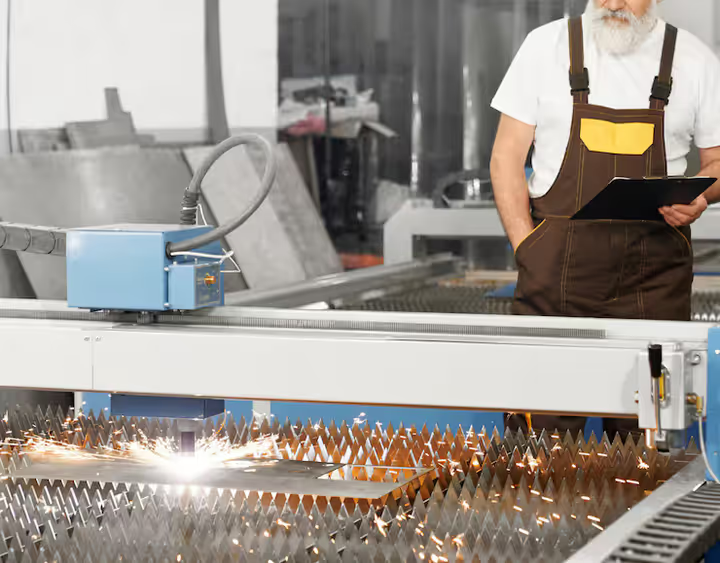
Fiber laser cutting systems are advanced industrial technologies designed for high-precision metal processing. They use a fiber-based laser source to generate a concentrated beam of light capable of cutting, shaping, and engraving various metals with exceptional accuracy. These systems evolved as a response to the growing demand for faster, cleaner, and more energy-efficient material processing methods in modern manufacturing.
Traditional cutting techniques such as mechanical shearing or plasma cutting often struggled with precision, material distortion, and higher maintenance complexity. Fiber laser technology emerged to overcome these limitations by offering superior beam quality, digital control, and stable performance across a wide range of industrial applications.
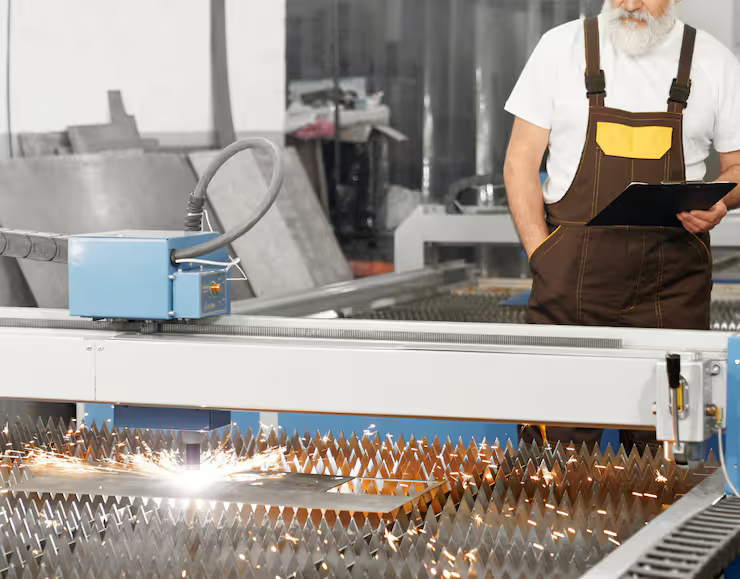
At their core, fiber laser cutting systems integrate optics, CNC control software, motion systems, and safety enclosures to deliver consistent cutting outcomes. Their development aligns closely with the rise of automation, smart factories, and data-driven production environments.
Why Fiber Laser Cutting Systems Matter in Today’s Manufacturing Landscape
Fiber laser cutting systems play a critical role in industries that demand precision, efficiency, and repeatability. From automotive components to electrical enclosures, these systems support complex fabrication requirements without compromising material integrity.
Manufacturers, engineers, plant managers, and production planners rely on fiber laser technology to address key challenges such as:
-
Maintaining dimensional accuracy at high processing speeds
-
Reducing material waste through optimized nesting
-
Supporting diverse metal types including stainless steel, aluminum, and mild steel
-
Enabling scalable production with minimal downtime
The importance of fiber laser cutting has increased as global manufacturing shifts toward lean operations and digital manufacturing workflows. These systems align well with Industry 4.0 principles by enabling real-time monitoring, automated parameter adjustment, and integration with enterprise resource planning platforms.
Key Benefits Driving Adoption
| Performance Area | Practical Impact |
|---|---|
| Precision Control | Tight tolerances and smooth edge quality |
| Energy Efficiency | Lower power loss due to direct fiber delivery |
| Production Speed | Faster cutting cycles for thin and medium sheets |
| Automation Ready | Compatible with robotic loading and unloading |
| Process Stability | Consistent output across long production runs |
Recent Developments and Trends in Fiber Laser Cutting Technology
Over the past year, fiber laser cutting systems have seen measurable advancements driven by software intelligence, laser source optimization, and sustainability goals.
In 2024, manufacturers introduced adaptive cutting algorithms that dynamically adjust laser power and focal position based on material thickness and reflectivity. These enhancements improved cutting consistency while reducing rework rates.
By early 2025, the focus shifted toward digital twin technology, allowing operators to simulate cutting paths and thermal behavior before production begins. This trend supports predictive maintenance and process optimization without interrupting shop-floor operations.
Another notable trend is the increased use of artificial intelligence in cut-path optimization. AI-driven nesting software helps maximize sheet utilization while maintaining structural integrity of components.
Technology Evolution Snapshot
| Year | Notable Advancement |
|---|---|
| 2023 | Improved fiber laser beam stability |
| 2024 | Adaptive cutting and smart sensors |
| 2025 | AI-assisted nesting and digital twins |
These developments reflect a broader movement toward intelligent manufacturing systems that prioritize precision, traceability, and operational transparency.
Regulatory Environment and Policy Considerations in India
In India, fiber laser cutting systems are influenced by industrial safety regulations, environmental guidelines, and national manufacturing initiatives. While the technology itself is not restricted, its deployment must align with established compliance frameworks.
The Factories Act and associated occupational safety standards emphasize proper enclosure design, laser safety interlocks, and operator training. These rules aim to minimize exposure risks associated with high-power laser equipment.
Environmental policies also affect laser cutting operations. Guidelines under the Ministry of Environment, Forest and Climate Change (MoEFCC) encourage energy-efficient machinery and controlled emissions, indirectly supporting the adoption of fiber laser systems due to their lower energy consumption compared to legacy technologies.
Additionally, government programs such as Make in India and Production Linked Incentive (PLI) schemes have encouraged modernization of manufacturing infrastructure. While not specific to laser technology, these initiatives promote advanced fabrication tools as part of broader industrial growth strategies.
Tools, Software, and Knowledge Resources Supporting Fiber Laser Cutting
A wide ecosystem of digital tools and educational resources supports effective use and understanding of fiber laser cutting systems. These resources focus on process optimization, safety awareness, and technical learning.
Commonly Used Digital Tools
-
CNC control software for path planning and motion control
-
Laser parameter calculators for material-specific settings
-
Nesting optimization software for sheet utilization
-
Predictive maintenance dashboards for system health monitoring
Learning and Reference Resources
-
Industry standards documentation for laser safety
-
Technical whitepapers on fiber laser beam physics
-
Manufacturing forums focused on CNC and laser processing
-
Online knowledge bases covering material behavior under laser cutting
These tools and resources help professionals improve decision-making, maintain compliance, and stay updated on evolving best practices without relying on promotional content.
Frequently Asked Questions About Fiber Laser Cutting Systems
What materials are commonly processed using fiber laser cutting systems?
Fiber laser cutting systems are widely used for processing metals such as stainless steel, carbon steel, aluminum, brass, and copper. Their wavelength allows efficient interaction with reflective materials.
How does fiber laser cutting differ from CO₂ laser cutting?
Fiber lasers use solid-state technology with optical fibers, offering higher electrical efficiency, faster startup times, and reduced maintenance complexity compared to gas-based CO₂ lasers.
Are fiber laser cutting systems suitable for high-precision applications?
Yes, they are well suited for applications requiring tight tolerances, fine contours, and clean edges, especially in electronics, automotive, and precision engineering sectors.
What role does software play in fiber laser cutting accuracy?
Software controls motion paths, laser parameters, and synchronization between axes. Advanced software improves accuracy by compensating for thermal effects and material variation.
How do safety standards apply to fiber laser cutting systems?
Safety standards require enclosed work areas, interlock systems, warning indicators, and operator awareness to manage risks associated with high-energy laser beams.
Final Thoughts and Practical Takeaways
Fiber laser cutting systems represent a significant advancement in modern metal fabrication. Their combination of precision, efficiency, and digital compatibility makes them a cornerstone technology in advanced manufacturing environments.
As recent innovations continue to enhance automation and intelligence, understanding the fundamentals and operational context of fiber laser cutting becomes increasingly important. Regulatory alignment, proper tooling, and informed decision-making ensure that these systems contribute effectively to sustainable and high-quality production outcomes.
For professionals seeking reliable technical knowledge, fiber laser cutting systems offer a compelling example of how engineering innovation meets practical manufacturing needs.