Industrial Boilers Guide: Designs, Fuel Types, Steam Production, Uses and Key Considerations
Industrial boilers are pressure vessels designed to generate steam or hot water by transferring heat from a fuel or another heat source. They are used in factories, processing plants, hospitals, food facilities, textile operations, chemical production, and many other settings where controlled heat or steam is needed. Understanding industrial boiler designs, fuel types, steam production, uses, and key considerations helps readers see how these systems fit into industrial processes.
Context
What an Industrial Boiler Is
An industrial boiler contains water and uses heat to raise its temperature until steam is produced, or until hot water reaches a required operating temperature. Steam can then travel through pipes to equipment such as heat exchangers, dryers, sterilizers, heaters, and process vessels.
Boiler technology developed from early steam systems used to power machinery and transportation. As industrial production expanded, boilers became important sources of process heat. Modern systems use sensors, control equipment, improved combustion methods, and heat-recovery components to manage steam generation more precisely.
How Steam Production Works
The basic process has several stages: water enters the boiler, heat is transferred through heating surfaces, water changes into steam, and the steam moves to the point where it is used. Feedwater treatment is also important because dissolved minerals and impurities can form deposits or contribute to corrosion.
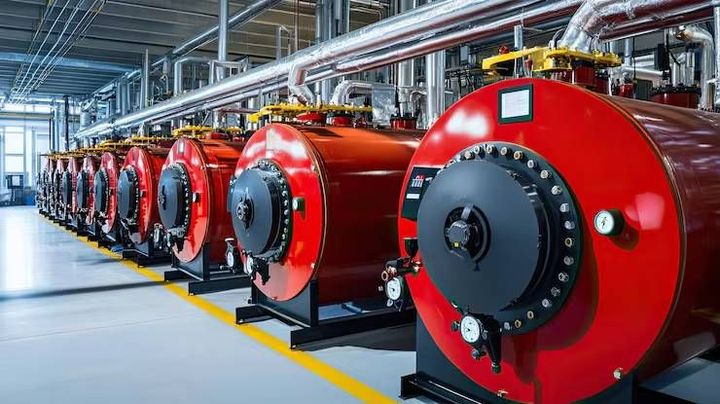
Common boiler components include the furnace or combustion chamber, burner or fuel system, heat-transfer surfaces, steam drum in applicable designs, feedwater system, safety valves, controls, and flue-gas outlet. The exact arrangement depends on the boiler design and application.
Importance
Why Industries Use Boilers
Industrial boilers provide a controlled source of thermal energy for processes that require steam or hot water. In a textile facility, steam may support dyeing, drying, or finishing processes. In food processing, it can be used for heating, cooking, cleaning, or sterilization. Chemical and pharmaceutical operations can also use steam for controlled heating and process conditions.
Boiler operation also affects energy use, workplace safety, emissions, water management, and production continuity. Poor combustion, inadequate water treatment, heat loss, or incorrect pressure control can reduce system performance and create safety concerns.
Common Industrial Boiler Uses
Typical applications include:
- Process heating for manufacturing operations
- Steam generation for turbines or other equipment
- Heating and drying in textile and paper production
- Food processing and controlled cooking
- Sterilization and sanitation in applicable facilities
- Heating of tanks, vessels, and heat exchangers
- Humidification and building heat in selected industrial environments
Main Boiler Designs
Two broad designs are fire-tube and water-tube boilers. In a fire-tube boiler, hot gases pass through tubes surrounded by water. In a water-tube boiler, water flows through tubes that are heated externally by combustion gases.
Fire-tube systems are commonly associated with lower-pressure applications and relatively compact arrangements. Water-tube designs can be used for higher pressure and larger steam-generation requirements. Other configurations include electric boilers, once-through boilers, waste-heat boilers, and biomass systems.
| Boiler design | Basic principle | Typical application |
|---|---|---|
| Fire-tube | Hot gases move through tubes surrounded by water | General process heating |
| Water-tube | Water moves through heated tubes | Higher-pressure steam generation |
| Electric | Electrical energy heats water | Sites with suitable electrical supply |
| Waste-heat | Recovers heat from another process | Industrial heat recovery |
| Biomass | Uses organic solid fuel for heat | Facilities with suitable biomass resources |
Recent Updates
Efficiency and Digital Controls
From 2024 through 2026, industrial boiler development has increasingly focused on energy efficiency, heat recovery, emissions monitoring, automation, and digital controls. Sensors can track pressure, temperature, water level, oxygen, and other operating conditions, allowing control systems to adjust combustion and feedwater conditions.
Heat recovery is another continuing area of attention. Economizers can recover heat from flue gases to preheat feedwater, while condensate recovery can return usable thermal energy and treated water to the boiler system.
Fuel Flexibility and Lower-Emission Operation
Industrial facilities are also examining fuel flexibility, biomass use, electrification, and combinations of heat sources where site conditions permit. The practical choice depends on fuel availability, boiler design, steam requirements, environmental rules, and infrastructure.
India's energy-efficiency framework continues to cover energy-intensive industries. The Bureau of Energy Efficiency reported 1,333 covered energy-intensive industries and 25.78 million tonnes of oil equivalent in energy savings under its 2025 Perform, Achieve and Trade information. This broader focus on industrial energy performance is relevant to facilities that operate steam systems.
BEE has also published recent material concerning carbon-market mechanisms, including a 2026 draft project design document for a biomass-based boiler project. This indicates continued attention to emissions reduction and measurable industrial energy projects.
Laws or Policies
Boiler Safety Rules in India
India's regulatory framework changed with the Boilers Act, 2025, which replaced the earlier central legal framework for boilers. The Act was enacted in April 2025 and came into force on May 1, 2025. It addresses boiler regulation, safety of life and property, and registration and inspection during manufacture, erection, and use.
The law applies broadly to boilers and boiler components, subject to specified exclusions. It also provides for a Central Boilers Board and rules concerning registration, inspection, and safety requirements. Individual installations may also be subject to state-level procedures and applicable technical requirements.
Environmental Requirements
Industrial boilers can also fall under environmental requirements concerning air emissions. Central Pollution Control Board material identifies emission standards for industrial boilers based on fuel and industrial category, with parameters including sulphur dioxide and nitrogen oxides. State Pollution Control Boards may apply additional conditions based on location and applicable permissions.
Facilities therefore need to consider both boiler safety requirements and environmental controls. Applicable rules can differ according to boiler capacity, fuel, industry, location, and operating conditions, so the relevant central and state authorities remain important sources for current requirements.
Tools and Resources
Useful Planning and Monitoring Tools
Several tools can help readers understand boiler operation and energy performance:
- Steam tables: Used to relate pressure, temperature, enthalpy, and other steam properties.
- Boiler efficiency calculators: Used to estimate energy conversion performance from fuel and steam data.
- Fuel-to-steam worksheets: Used to compare fuel input with steam output.
- Blowdown calculators: Used to estimate water and heat losses associated with boiler blowdown.
- Condensate-return worksheets: Used to examine how much hot condensate returns to the feedwater system.
- Emissions monitoring records: Used to track relevant stack parameters and regulatory measurements.
- Manufacturer manuals and technical drawings: Used to understand operating limits, components, and maintenance requirements.
- Government resources: India Code, the Bureau of Energy Efficiency, and the Central Pollution Control Board provide regulatory and energy-related information.
These tools are most useful when the input data is accurate and the calculation method matches the particular boiler configuration.
FAQs
What are the main industrial boiler designs?
The main designs include fire-tube and water-tube boilers. Other configurations include electric, biomass, once-through, and waste-heat boilers. The appropriate design depends on pressure, steam demand, fuel, available space, water quality, and process requirements.
Which fuel types are used in industrial boilers?
Industrial boilers can use natural gas, diesel and other liquid fuels, coal, biomass, biogas, and electricity, depending on the system. Fuel selection is influenced by availability, emissions requirements, boiler design, energy infrastructure, and operating conditions.
How does an industrial boiler produce steam?
An industrial boiler transfers heat to water until the water reaches the conditions needed for steam generation. The resulting steam is separated or controlled as required and then distributed through a steam system to process equipment.
What are industrial boilers used for?
Industrial boilers are used for process heating, drying, cooking, sterilization, humidification, heat exchangers, and other operations requiring controlled steam or hot water. Their applications vary across textile, food, chemical, paper, manufacturing, and other industries.
What should be considered when evaluating a boiler system?
Key considerations include steam capacity, operating pressure, fuel type, water treatment, combustion efficiency, emissions, safety controls, space, heat recovery, maintenance requirements, and applicable regulations. The operating profile of the facility is also important because steam demand can vary over time.
Conclusion
Industrial boilers convert fuel or another energy source into useful steam or hot water for many industrial processes. Fire-tube, water-tube, electric, biomass, and waste-heat designs serve different operating conditions and requirements. Recent developments emphasize energy efficiency, digital monitoring, heat recovery, fuel flexibility, and emissions management. In India, boiler safety and environmental requirements form an important part of planning, operation, registration, inspection, and monitoring.