Hydraulic Breakers Insights: Breaker Types, Energy Transfer, Applications and Efficiency Factors
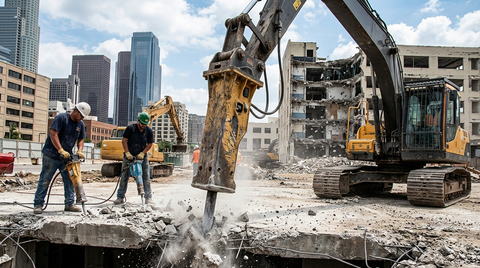
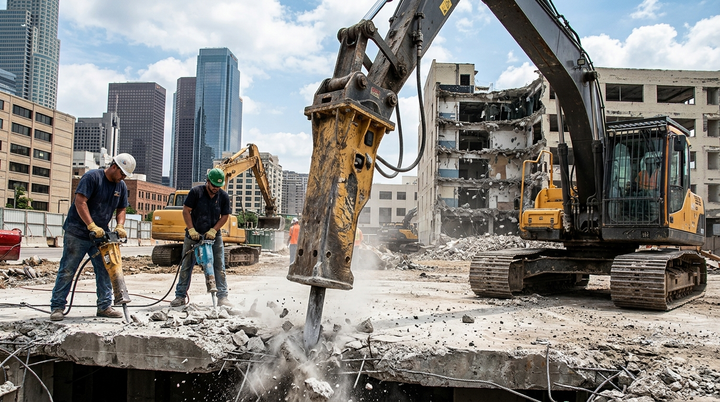
Hydraulic breakers are attachments used with excavators, backhoe loaders, skid-steer loaders, and other construction equipment to break hard materials. They are sometimes called hydraulic hammers because they use hydraulic pressure from the host machine to create repeated impacts against a working tool. The tool transfers this impact into materials such as concrete, rock, asphalt, masonry, and compacted ground.
The basic idea is relatively simple. Hydraulic fluid from the excavator enters the breaker and moves an internal piston. The piston strikes a tool, such as a chisel or moil point, and the resulting impact travels into the material. This process converts hydraulic energy into mechanical impact energy.
How hydraulic breakers developed
Early breaking work often depended on manual tools, mechanical hammers, drilling, or other equipment. As hydraulic excavators became common, hydraulic breakers provided a way to perform impact work through an attachment connected directly to the machine's hydraulic system.
Modern hydraulic breakers are available in different sizes and configurations. Small breakers can be used with compact equipment for concrete or masonry work, while larger units are designed for quarrying, heavy demolition, and hard rock applications.
Main components
A hydraulic breaker normally contains several important parts:
- Hydraulic inlet and outlet passages that carry fluid between the host machine and breaker
- A piston that moves back and forth inside the breaker body
- A working tool that contacts the material
- A front head that supports the lower section of the tool
- Bushings that help guide the working tool
- Accumulator or energy-storage components in some designs
- Housing and vibration-control elements that protect internal parts and the host machine
The exact arrangement differs between breaker designs, but the basic purpose remains the same: transfer hydraulic energy into controlled impact energy.
Importance
Hydraulic breakers are important because many construction and infrastructure materials cannot be removed efficiently with digging alone. Concrete foundations, road surfaces, natural rock, masonry structures, and frozen or heavily compacted ground can require concentrated impact energy.
Their applications affect several areas of construction and infrastructure work. Demolition teams may use breakers to reduce concrete structures into manageable sections, while road projects may use them to remove pavement. Quarry and excavation operations can use larger breakers for secondary rock breaking.
Common applications
Hydraulic breakers can be found in a wide range of work environments, including:
- Building and structural demolition
- Road and pavement removal
- Foundation and slab removal
- Rock excavation
- Quarry operations
- Trenching in hard ground
- Tunnel and underground construction
- Utility infrastructure projects
- Concrete reduction and site preparation
- Emergency access through damaged masonry
The attachment can also reduce the need to move separate impact equipment into areas where an excavator is already operating.
Why energy transfer matters
A breaker does not simply depend on the size of its piston. Effective operation depends on how hydraulic pressure, fluid flow, piston movement, tool geometry, and material resistance interact.
If hydraulic flow is too low, the breaker may not reach its intended operating behavior. If pressure or flow is unsuitable for the attachment, excessive heat, inefficient operation, or component damage may occur. Matching the breaker with the host machine's hydraulic specifications is therefore an important part of equipment selection and operation.
Recent Updates
Hydraulic breaker development during 2024–2026 has generally followed wider construction-equipment trends involving improved hydraulics, vibration control, electronic monitoring, attachment compatibility, and equipment efficiency. Recent excavator developments have also emphasized telematics and expanded attachment capabilities.
Improved hydraulic efficiency
Recent breaker designs have focused on directing hydraulic energy more effectively toward the impact mechanism. For example, a large hydraulic breaker introduced during this period incorporated revised hydraulic routing intended to increase impact energy while maintaining specified pressure and flow ranges.
This reflects a broader engineering focus on reducing unnecessary energy losses. The practical result depends on the complete combination of breaker, excavator, hydraulic settings, material, and operating technique.
Vibration and noise control
Vibration-damping designs have also received attention. Some newer breakers use housing and damping arrangements intended to reduce the transfer of vibration to the host machine and operator. Recent attachment designs have included dedicated vibration-control structures and sound-reduction features.
Noise remains an important consideration because hydraulic breakers generate repeated high-energy impacts. Construction-equipment manufacturers and regulators therefore continue to address operator exposure and environmental noise.
Telematics and equipment monitoring
Another wider trend is the increasing use of telematics in excavators. These systems can record information such as operating hours, machine activity, idle periods, and fault information. Such data can help equipment managers understand operating patterns and identify unusual conditions.
For hydraulic breakers, monitoring can become particularly useful when combined with information about attachment usage, hydraulic conditions, and operating hours.
Attachment compatibility
Attachment systems are also becoming more connected. Industry developments include standardized electrical connections between automatic couplers and work tools, helping different compatible attachments communicate with the host machine.
This trend is relevant to hydraulic breakers because modern excavators increasingly manage attachments through hydraulic, electronic, and machine-control systems rather than treating an attachment as an entirely separate mechanical component.
Laws or Policies
In India, hydraulic breakers can be affected by several areas of regulation because they are normally used as part of construction equipment and can contribute to noise and construction-related environmental impacts.
Noise requirements
India's Noise Pollution (Regulation and Control) Rules establish ambient noise standards for different area categories and provide requirements for controlling noise-producing activities. The rules also address construction-related sound and restrictions in residential areas and silence zones.
For projects using hydraulic breakers, the applicable requirements can therefore depend on the location, surrounding land use, local authority requirements, and operating conditions.
Construction equipment standards
India has also established requirements for construction equipment vehicles covering areas such as safety and noise emissions. Ministry of Road Transport and Highways documents specify requirements for construction equipment vehicles, including noise limits at operator positions and other measurement conditions. Phase-II noise requirements were specified for vehicles manufactured from 2024 onward.
The implementation timeline for certain Construction Equipment Vehicle emission and safety requirements was also revised during 2024, with the Ministry subsequently identifying January 2025 as the revised implementation point for specified requirements.
Construction and demolition waste
Construction and demolition activities are also influenced by India's updated environmental framework. The Environment (Construction and Demolition) Waste Management Rules, 2025 superseded the earlier 2016 framework and came into effect from April 2026. The rules apply to construction, demolition, remodeling, renovation, and repair activities.
For projects involving concrete or masonry breaking, waste handling and material movement therefore form part of the wider regulatory context.
Tools and Resources
Several resources can help readers understand hydraulic breakers and their operating environment.
Hydraulic specifications
An excavator's operator manual and the attachment manufacturer's technical documentation are useful starting points. Important specifications commonly include hydraulic flow range, operating pressure, carrier weight range, tool dimensions, impact frequency, and recommended hydraulic settings.
Operating measurements
A basic equipment record can track:
- Excavator operating hours
- Breaker operating hours
- Hydraulic temperature
- Hydraulic pressure
- Fluid flow
- Impact frequency
- Tool condition
- Idle periods
- Material type
- Breaker position during operation
These measurements can help identify changes in operating behavior over time.
Regulatory resources
For readers in India, the Central Pollution Control Board website provides information about noise rules, construction and demolition waste requirements, and environmental guidance. The Ministry of Road Transport and Highways publishes notifications and standards related to construction equipment vehicles.
Equipment manuals, technical specification sheets, hydraulic-flow calculators, and maintenance records can also help operators understand whether a breaker and host machine are being used within their specified operating ranges.
Breaker type comparison
| Breaker Type | Typical Equipment | Common Applications | Main Consideration |
|---|---|---|---|
| Light hydraulic breaker | Mini excavator, compact loader | Masonry, light concrete, small pavement areas | Limited impact energy |
| Medium hydraulic breaker | Mid-size excavator | Concrete, road work, trenching | Hydraulic matching |
| Heavy hydraulic breaker | Large excavator | Rock, heavy demolition, quarry work | High hydraulic and structural demands |
| Silenced breaker | Various excavators | Urban and noise-sensitive areas | Noise and vibration control |
| Underwater-capable breaker | Suitable excavator systems | Marine and underwater breaking | Sealing and operating conditions |
The table represents general equipment categories rather than fixed industry classifications. Actual breaker sizes and specifications vary among manufacturers and machine models.
FAQs
What are hydraulic breakers used for?
Hydraulic breakers are used to break concrete, rock, asphalt, masonry, and other hard materials. They are commonly attached to excavators and similar construction machines.
How does a hydraulic breaker transfer energy?
A hydraulic breaker receives pressurized fluid from the host machine. The fluid moves an internal piston, which strikes a working tool and transfers impact energy into the material.
What types of hydraulic breakers are available?
Hydraulic breaker types generally vary by size, impact energy, carrier-machine requirements, housing design, and intended application. Light, medium, heavy, silenced, and specialized configurations are common categories.
What factors affect hydraulic breaker efficiency?
Hydraulic flow, operating pressure, piston movement, tool condition, material hardness, breaker position, host-machine compatibility, and operator technique can all influence efficiency.
Are hydraulic breakers affected by noise regulations in India?
Yes. Hydraulic breakers can generate significant impact noise, so their use may be affected by India's noise-control framework and local requirements, particularly around residential areas and designated silence zones.
Conclusion
Hydraulic breakers convert hydraulic energy into repeated mechanical impacts for breaking concrete, rock, asphalt, masonry, and other hard materials. Their performance depends on energy transfer, hydraulic compatibility, breaker design, material conditions, tool condition, and operating technique. Developments from 2024–2026 have included improvements in hydraulic routing, vibration control, monitoring technology, and attachment compatibility. In India, noise, construction-equipment, and construction-and-demolition waste regulations form an important part of the operating environment.